Rain Rider
Words By Meghan Reed, Art By Braden Maxwell
That fated Tuesday, Uma woke to a wet tapping between her eyes. A mist hung over her face, and above her a patch of drizzling rain trickled from a gray milky cloud that swirled across the ceiling. She swung out of bed, her feet splashing into a puddle on the floor. Confused, Uma placed a rain boot under the leak and put on her soggy slippers. Her apartment was thick with humidity as she followed the rain clouds into the living room only to find another patch of rain over her grandmother’s antique end table. Her best guess was that the old building’s ancient pipes had finally given way.
Kit, Uma’s Jack Russell, stood shaking in the middle of the room, stranded on the little island of her ottoman. Uma got the bucket from the broom closet and placed it under the rain, then took Kit to the safety of the kitchen. Kit looked up at her owner pitifully and put her wet paw on Uma’s leg. Uma wrapped her in the yellow tea towel that hung from the oven handle and held her close.
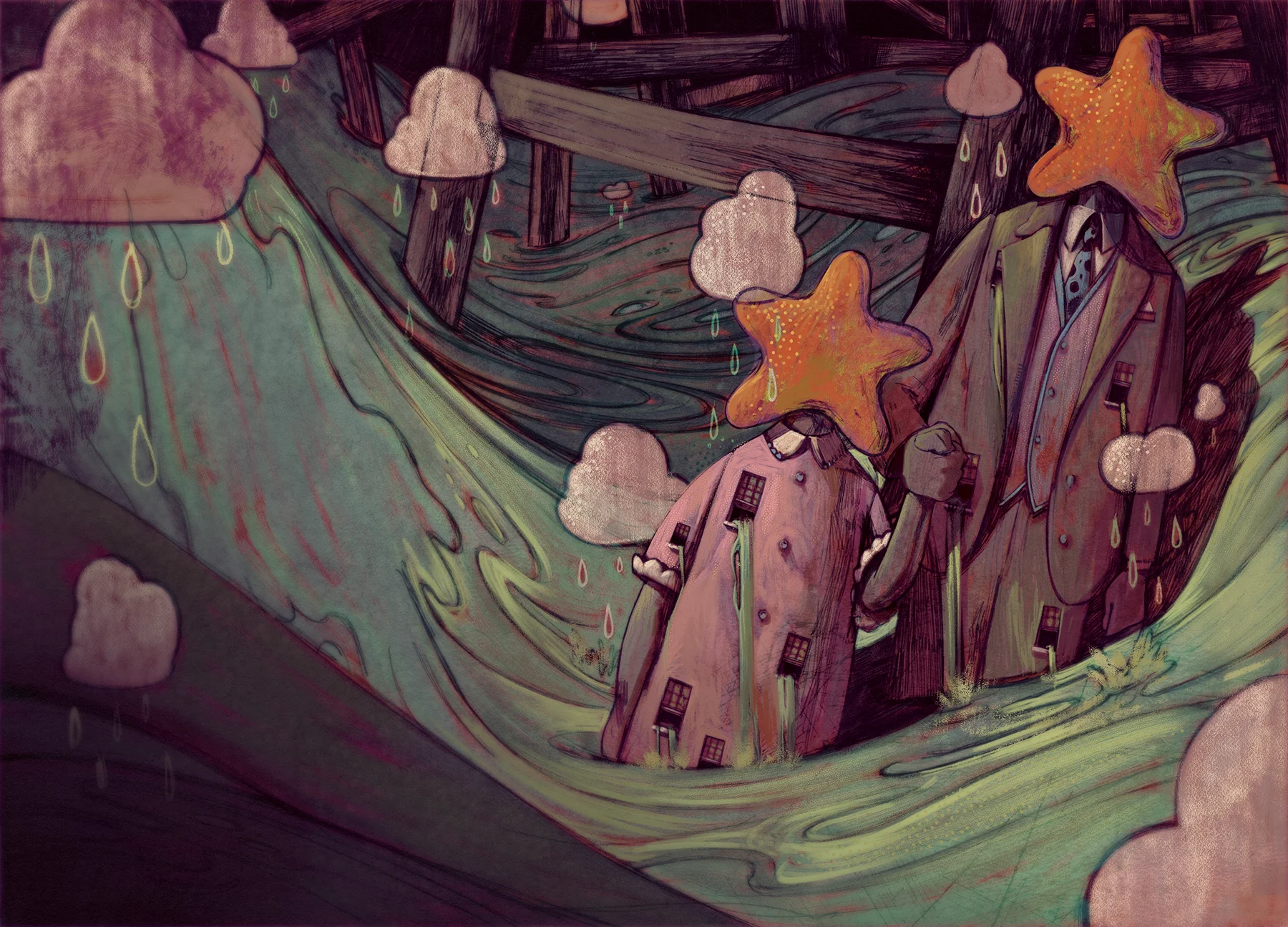
On the mantel she spotted her favorite figurine, the one she and her father carved together, being pelted with water. She placed Kit down and using the tea towel, she wiped along the figures’ bodies; a girl and her father, hand-in- hand with starfish for heads. Uma set the carving on the counter next to stacks of unwashed dishes, a reminder that she hadn’t left the apartment in three days.
Out of the kitchen window, the November day shone brightly, not a cloud in the sky. In the near distance, the beach was flooded with half- dressed families enjoying the warm sun. This was an unusual treat for Meridian, Oregon, a coastal village that stretched into the blanket of the Pacific. But Uma spent the morning unplugging appliances, lifting furniture off the ground, and mopping. The rain was intermittent, drizzling for a few hours and then stopping. Sometimes the entire ceiling rained, other times only one room. By the end of the day, the rain had stopped. She’d only just finished mopping up the water when a new patch of rain erupted from her kitchen ceiling with a clap of thunder.
Uma ditched the mop and decided to call it a day. She whistled for Kit, who ran to her side. She picked up the small dog and put her in her lap as she settled on the windowsill, the only dry place left. Uma closed her eyes, listening to the sound of children playing in the park across the street.

On Thursday, Uma’s mother paid her a surprise visit. Through the peephole, Uma saw her holding a bottle of white wine and a large, insulated bag. Uma struggled with the door, the suction holding it closed. When the door finally opened, water rushed out over her mother’s patent leather loafers and down the stairs, carrying away leaves and the Johnson’s Welcome mat.
“So here you are. I’ve been trying to call all day, Uma. Honestly, I was worried. When you said you had a leak, I didn’t think it was this bad.” She thrust the bottle into Uma’s hands. “Here, I’m trying to cut back. Pour us a glass.” Yanking off her shoes, she waded into the kitchen and sat on a barstool, her toes grazing the surface of the water. Kit, who had claimed sanctuary on the counter, ran up to her, tail wagging. She jumped into her mother’s lap and licked her face. Her mother smiled and scratched Kit’s favorite place, behind her ears. “Nana would roll in her grave if she knew you’d let her favorite end table bubble. Bubble, Uma.”
“I’ve been trying to clean up.”
“You should call the plumber again is what you should do, this water is out of control. Is it coming from your upstairs neighbor?” Her mother put Kit back on the counter and waded through the apartment, assessing the damage.
“Old pipes.”
“You and Kit—you come stay at my place while this gets fixed. It’s not safe for you here.” Her mother picked up the crocheted coasters that Uma’s Aunt Traci had made her off the coffee table and brought them, dripping, to the sink. She looked outside. “Some don’t mind the lack of rain. Evelyn, my hairdresser, even said the town is planning a big outdoor festival. Art, music, rides, food, everything. We could go together.”
Uma knew what she was trying to do— she was trying to fix things again. Her mother started to take out the dish she’d brought in the insulated bag.
“I made your favorite and extra—chicken pot pie. Just how you like it.”
“You didn’t have to.”
“Hush, I wanted to.”
“Well, I didn’t need you to.” Her mother put her hand on Uma’s. Uma knew she made these unannounced drop ins to check on her. She worried Uma wasn’t eating, wasn’t going out.
“I saw Rich the other day at Fred Meyer,” her mother said.
Uma wished the rains would start again. Though she never meant to, her mother knew how to open old wounds like a practiced surgeon. It only succeeded in reminding Uma that she was still alone. Rich and Uma were not “the right fit,” like a too-loose pair of socks which migrated down your ankles that you kept having to hike back up throughout the day. If that was all, it wouldn’t have felt so terrible. But Uma sensed that she specifically was not the right fit. For anyone. Something in her makeup was jumbled.
Once when she was fourteen, she’d babysat her neighbor’s two children. The woman had said maybe she could be “their regular babysitter.” She fed the children chicken nuggets in the shape of dinosaurs, let them put nearly twenty-five band aids on her body to cure various made-up ailments, everything she had understood a babysitter should do. But when she returned from tidying the kitchen, the children had drawn all over themselves with permanent marker, and the couch, too, had fallen victim to the ink. She was able to scrub most of it from their skin, but not from the cushions. She’d put them in the wash, but the marker had set in. Two weeks later, Uma had asked her mother why the woman hadn’t reached out again. Her mother told her: it just wasn’t the right fit.
Or during a college teambuilding exercise, when a virile boy with brown freckles was picking from a crop of freshmen for a human pyramid competition. He passed her over then later he’d said sorry, but she just wasn’t the right build for what he needed, you know?
“I wouldn’t have known where to put you. Too small to hold someone, but not small enough to be held. Nothing personal. Just wanted us to win!”
For Uma, these types of interactions had seeped in. She wasn’t built to take care of children. She wasn’t built for being in a human pyramid. She wasn’t built for contributing to a twelve-hour session of the hit strategy game, Settlers of Catan. Instead, she’d sat by Rich’s elbow, crunching pretzel sticks until her mouth blistered, and murmuring each time she left to go to the bathroom, “Does anyone need anything from the kitchen?”
She had always been searching for that perfect outlet to snuggle into. But she was a plug with a bent prong. Yet Uma had loved the idea of Rich—of her and Rich together—and the thought that she was finally part of that exclusive class of people who belonged to someone and made statements like; We are summering in Florence, We just bought a car, We can’t stand pistachios!
She had loved belonging to someone so much that she was not picky. So what if it wasn’t a perfect fit? She could adjust—could mold herself into different shapes. Rich didn’t like going out much; therefore Uma stayed in with him. Rich adored video games, so she sat next to him when he played and cheered him on.
The saddest part was that there was nothing wrong with Rich. He never raised his voice or belittled her. He wasn’t an annoying, testosterone-pumped meathead. Sometimes they had real conversations about important things, like the state of the world, the economy, and all the terrible decisions their friends made. They did healthy couples’ activities, like ice skating and pumpkin carving. She remembered their time together as generally pleasant.
After he delivered the news to her eight months ago—the three C’s of no longer wanting to cohabitate, comingle, or copulate—Uma tried her best to buck up and get on with her life. But he’d said precisely what she most feared; that they just didn’t mesh, didn’t fit. Rich felt the relationship had plateaued and run its course. All that post-breakup week, she’d lain in bed imagining she was a runner falling on her face just shy of the finish line. She had run her course.
She placed a modestly-full wine glass in front of her mother, who smiled and took a sip of the cheap pinot grigio.
“What, you don’t want any?”
“It’s not even lunchtime.”
“Oh, please, that’s why they invented brunch.” Her mother finished her glass and motioned for more as she found plates in the cabinet and dished out the steaming casserole. “Anyway, Rich. He’s expecting a baby. I thought you’d like an update since you’re on good terms.”
They were on good terms. But Rich had always said he never wanted children. So now she knew that he just didn’t want children with her. And that this other woman was such a good fit that he had evidently wanted to mix themselves all up together, the ultimate DNA cocktail of romantic commitment, to create a tiny replica of themselves. Both of them in a single body, a living testament to their fitting together so well.
When Uma didn’t move, her mother took the bottle and filled her glass almost to the brim. A wave of liquid sloshed out over the lip and onto the marble island.
Uma looked at the pot pie’s blond crust. Chunks of bright carrot and pea oozed out of the sides. She ran to the bathroom, barely making it to the toilet before she threw up. It spewed from her mouth, tasting of clouds, and when she looked down into the toilet bowl, she realized it was a clear liquid. She slid to the ground and curled up on the tile floor. Half her face was submerged in water, mouth open, panting, like an air-drowned fish. The cool tiles soothed her flushed cheeks.
From her prone position, she spied the wall tile her father had accidentally smashed with a wrench when he fixed her door. The only times she had felt like she fit was when she had been with her father. He got her and she got him. Simple, like breathing. When he passed a year and a half ago, the idea of her fitting all but faded away with him. And then, the breakup.
When she returned, her mother asked, “Have you thought about going back to work? It’s been so long. You know they won’t hold that position forever.” Uma lifted herself onto a seat at the counter.
“I don’t know. Freelance is ok.” And then, “I talked to Kim last week. They’re looking for someone to take my place.” She plunged her feet into the water swirling around the floor and drops flew in all directions. She took a sharp breath in. “I didn’t like sales anyway. I’m not a pushy person.” In truth, Uma eventually took a leave of absence after Rich broke up with her. It all sounded so dramatic packaged that way. When she began hyperventilating at her desk because of a paperwork snafu, her boss suggested she take some time for herself. The breakup wasn’t the sole reason for her mental health’s rapid decline (father, stroke), but it had been the final straw.
Rich had tried to stick it out when her father passed, to be there for her. But his thoughtfulness only hurt more when she found out he’d been waiting to break up with her until she was in a stable place.
Her mother flicked off a water droplet that had landed on her cheek. “Well, you can find something else you like better. Why don’t we come up with a list of things you like?” Her face brightened. “Running. You never run anymore. You loved it.” She paused, taking a sip before sheepishly adding, “It’s so nice out, maybe you should go today. Aunt Traci knows a good running club.”
Uma looked at the soggy coasters in the sink. She could see the insufferable pity in her mother’s eyes. She knew it well and it was suffocating. Uma remembered running with her father when he was still living. They were the best days of her week. But nothing could be fixed with a run anymore. Her mother began eating the pie. Uma didn’t feel sick anymore and couldn’t resist trying it.
“Do you still think about Dad every day?” She said through the hot mouthful.
Her mother’s lips tightened. “Don’t take this the wrong way. I loved him. You know that.” She shifted in her chair. Blew on her fork. Uma knew she didn’t love him like she did. Her father was a woodworker. He made beautiful, polished bowls, carved figurines; he knew how to read the wood, work with the grain. He’d kept his beloved creations-in-waiting—tree trunks, solid chunks of wood, scraps he’d found on the roadside—piled in the garage. It was the magic of possibility that excited him.
Uma remembered when, as a child, she accidentally broke off the hand of one of the figurines he was carving.
Instead of being angry, he’d said, “I think it looks better this way.” And since then, they had collaborated on projects together. He’d start, then hand it off to her; Uma would carve for a while, then give it back to him, passing the carving between them until both decided it was done. They wouldn’t have a plan for what a project was, they went by feeling. He never tried to fix the piece by going over her additions. Instead, he worked with her lines. It was exhilarating to her, creating this way—like they were linked. Whenever Uma felt stuck on what to do next, he encouraged her. Once when Uma was struggling with shaping the eyes of a seal, he told her, “Don’t fear mistakes, they are happy things. Everything you need is already inside you. All you have to do,” he’d cupped his hand around his ear, “is listen.”
Uma looked over to the counter, where she’d placed their figurine; the girl and father hand-in-hand. The father and daughter’s starfish heads had started to swell slightly from the moisture.
“But?” Uma asked.
“But sometimes I get up in the morning and don’t think of him until dinner. Sometimes it feels like days before I remember that I had a whole other life.” An expanding tickle surfaced in Uma’s throat. Kit walked over to Uma and butted her head into Uma’s shoulder. “I remember that there was a man named George who I lived with, and he would squeeze toothpaste on my brush each night and never know where the remote was. We’d watch I Love Lucy reruns while putting our puzzles together. We both loved the exact same pickles—cornichons. The two of us could eat cornichons all day long. It’s hard at night especially. I’ll lean over to say something to him, but he’s not there.” Her fork hovered over the plate. “All that forgetting, it makes me a bad person. But I miss him. I miss him even if I don’t remember it all the time.”
Uma placed a hand on her mother’s. After they had eaten, as her mother was leaving, she gave Uma a hug that lasted too long.
“Why don’t you come home with me? Please?”
“Maybe. I’ll—I’ll let you know.” Her mother looked disappointed.
“Well, get all this—” she gestured to the ceiling, the floors, at Uma, “—fixed.”
When her mother was gone, Uma called the plumber again, told him it was getting much worse. He came within the hour, declared that the pipes were fine, that there was no leak, and said he couldn’t explain the phenomenon. Management urged her and the other tenants in the building to move out.

Her neighbors sought emergency housing after the three-story complex had been deemed hazardous, but Uma refused to go. Every time she stood at her door ready to leave, it was impossible to put her hand on the knob—she couldn’t move. As the water level rose, she kept track of it with a measuring tape and marker. Two feet three inches and rising.
She covered the furniture in plastic, and when the couch became submerged, she tied pool floaties and rafts around its base so it would float. She put Kit in a raincoat and placed her on a raft in the shape of a yellow duck. To get around the apartment, she used the shower curtain rod to push off the ground and floated from kitchen, to living room, to bathroom.
By the end of the week, the entire ceiling was raining. She’d run out of buckets and pots. To cook, she used her small camp stove and tin cups to heat ramen noodles and the leftovers of the pot pie her mother had brought her. At night, she imagined waking to her head bobbing against the ceiling, her nose grating its popcorn finish. She would wake up, floating in the dark on her couch, Kit asleep beside her.
At first she wondered why the rain had moved inside, and why into her home, but after a while, she understood. Since a leak was ruled out, Uma knew it had something to do with her. It was a sense. Something about the rain felt personal. It was relentless, and that felt right to her—familiar. It was the same sensation of being inside a mind that was set on destruction. Now Uma only wondered who had sent the rain. She didn’t believe in God. If anything, she believed in nature; the power and wisdom of the natural world. Everything had its system, its order and place. There were rules. But now it seemed to be breaking those rules.
She’d given up on clothes because her skin could never get dry, so she went naked, surprised that she never got cold. She’d lie on her back on the couch letting her hand dip into the water, not knowing where her hand stopped and the water began.
A few days later, she was lying with her hand in the water, when there it was—a word. No, not a word, but a thought. But not her thought. A sensation. It was both inside and outside of her. She had the sense that something around her was hurting, trapped. She could feel it in her chest, in her bones, all-consuming. Then just as suddenly, it was gone. Uma lay still and quieted her breathing to try and feel it again, but there was only the sound of the unsteady water.

It was Day Thirty of indoor rain. Outside the drought persisted, another day of full sun. But in her apartment, it never stopped raining—lately, torrential storms full of wind and lightning. On those stormy nights, she huddled into her couch, closed her eyes, and clung to Kit. She feared being struck by the lightning that sent its bright roots across her ceiling, sometimes dangerously close to the water. But even still, she dreaded the thought of leaving. In those moments, she was consumed by the electric current in the air—held captive by its biting embrace—the hum of energy around her. Her skin pimpled and vibrated, her chest expanded and cried like tense bowstrings in response to the frequencies.

The water rose so high that she gave up measuring when it reached her mid-chest. Her mother delivered her groceries like they had agreed, and Uma hauled them up in a basket attached to a rope through the window. She gave Kit a kiss on the nose, placed her in the basket, and carefully passed her down, as her mother begged Uma to leave the apartment. But she refused. Kit barked frantically as her mother walked away, but Uma knew this was no place for a dog.
Sometimes she thought of leaving. She thought up an alternate life. If she would only walk out of her door, she could go live with her mother and Kit. They could watch those I Love Lucy reruns on the couch and eat cornichons until their lips puckered. Uma could put toothpaste on her mother’s brush at night, and everyday her mother would make them pot pies. Maybe she could find a job she didn’t hate, travel to new places, reignite lost friendships. Uma saw all of these possibilities as she waded through the cold water teeming with the objects of her life. Books drifted past her like leaves, furniture bloated below the surface, pillows sanded the floor among a coral reef of knick-knacks. She could leave it all behind. It would be so easy to step outside—to have a completely different life.
The lack of rain was beginning to show its teeth; the town was hurting. If the dry spell continued, it would be devastating. People started to notice the water that leaked out of Uma’s apartment. She felt terrible, imagining she was the cause, and tried to set up a drainage system for others to have water—running a big hose that the fire station dropped off from the second-story window down the side of the building so that it could track across the street to the park.
Crowds grew outside, protesters claiming she was the cause of the drought—the face of global warming. She had become a villain. The city brought in trucks and siphoned the water from the hose for the town to use, but still, the water in Uma’s apartment kept rising. Even though she let them have the water, every day people threw rocks, protested, and shouted unseemly adjectives at her, all to get her to leave—to have someone to be angry at for everything that was wrong in the world.
The building was condemned, and the city waited outside with a wrecking ball. They brought the police with a megaphone to talk her out. Finally, Uma grew tired of everyone being mad at her. Just to spite them, she threw down the hose that was channeling her water into the city. They really hated her then. She watched them flounder when they realized what she had done. Uma floated naked in front of her window where she knew they could see her and gave them all the finger.
That night, trying to sleep on the couch, she felt the walls could give way at any moment. The moans and creaks of water-on-building sounded like the belly of a large ship at sea being tossed by a great tsunami. The noises filled her ears until she couldn’t think. She took to the water to see if it was quieter under the surface. She held her breath, let her body dip under, and swam. After a few minutes, she found that she didn’t feel the burning in her lungs from lack of oxygen, that she was able to stay underwater. So, she started testing out her ability. She would sit cross-legged on her living room floor, on what had been her father’s favorite rug; close her eyes, and after an hour, she still didn’t need to breathe.
Her swimming improved. It was thrilling to shoot, rocket-like, under the water, dodging furniture; to avoid the corner of the kitchen island, to swim under the dining table, all the chairs floating above her.
That next morning while she swam, she noticed that her skin had started to change, to become silvery, translucent, her blue veins rising and brightening. When she looked at her hands under the water, they were hard to see. And there was something else, a presence from the molecules around her. It seemed that the water started to move with her, to give her its power. She realized it was alive, like her—it breathed too, just differently; in long reaches, the closing and opening of arms like wings in flight.
By now she had abandoned her couch. She took to drifting across the living room in her sleep. She never sank. It was a pleasant drifting, like she was on a journey. She wondered if this was what early sailors felt as they navigated the stars. But she didn’t have any stars, so how did she know where to go?
After becoming so accustomed to the water, all she wanted was to swim, faster and longer and harder. It was no longer a desire; it was a need. The water and she had started sharing a like-mind. It was simple now to sense the water’s emotions, and it was satisfied with her, with her enjoyment of its power. So, it gave her more. It gave and gave, and Uma saw these abilities as the water’s gifts to her. She felt a tenderness toward her from it, as if from a friend. And that’s what it resembled, or, rather, what it was; being with a friend who understood you so well that it was like being with yourself.
Finally, she had been chosen, desired, deemed worthy of attention. Uma had met expectations and exceeded them. For the water, Uma was not lacking, but a prime specimen of affection bursting at the seams with unmet potential.
It wasn’t long before Uma decided that her apartment was too small for them. Mid-swim, the walls always came too quickly and she was frustrated by being in that tank of a home, always bumping against a boundary. She and the water needed open ocean—to be uninhibited.
If the town didn’t want her, she would leave. Let them have their rain.
She and the water formed a plan. To build pressure, she clogged every leak in the house. The beach was close enough to make a clean go of it. The water’s power became part of her—and it was ready, surging to be set free. She felt its cool anticipation.
After a few hours, the walls started to groan from the weight. At the breaking point, the water begin to stir and she braced in its excitement, waited for the moment—the release.
The windows gave first, then the side wall. She was sucked under the water, and quickly, desperately into the open air. She gasped, the breeze hitting her and the sun shining in her eyes for the first time in over a month. The water cupped her ankles, supporting her above the tidal wave. She saw the beach ahead and worked with the water, pushing toward the ocean. A levity coursed through her body at the sight—that blue forever, that ocean, enough water to swim unceasing.
The closer they got, the more excited the water became. And she felt the ocean’s excitement too, it beckoned to them with outstretched arms. Uma smiled, laughed, and with a crash, she plunged forward into the violence of water meeting itself. It was like hitting concrete. Her lungs filled with water, she heard crunching snaps—her teeth floated in front of her face. Panicked, she tried to swim to the surface, but found she didn’t know which way was up. The water held her captive. The ocean felt different than the water in her apartment, more wild, vast, its power unbelievable. The energy—that water memory came to her—slid through her, slick and humming. She felt herself dissolving, bit-by-bit. She was no longer flesh. Becoming water was like going home to your beginning, to that little flame in the night.
She sensed that in this way, you turn back into what made you—into spark and dust, unrefined prokaryotes from which everything sprung forth. Carbon-devouring simpletons. She saw now that through the eons, everyone had been strained through the sieve of the universe; sifted, morphed, remade into a separate thing. That each year, we were pushed one more step away from the earth.
But that separation was being unmade in her now. She was both expanding and shrinking, pressed like a diamond into a microscopic puzzle piece. Her place in the world had never been clearer: she understood her function for the first time. Here was where she fit—a molecule among billions. Cells strung out in a happy line; tingling little ornaments unburdened by thought. All with their objective. She would become the stingray, the seal, and the shark that ate them. She would feed starfish, urchin, and plankton. She would transform into algae and the rain again and again; be consumed, recycled, useful. Why sit in a room, when you can be the ocean?
Uma was hot and chilled at the same time; it was everything she had ever wanted and everything she wanted to avoid. Both freeing and terrifying. She knew that being unmade would not be easy, but it would be simple. She could become one small stitch in the net of the earth. She could finally fit. The pull toward the sensory-less depth confronted her with a choice: return to shore or dissolve.

On that afternoon, the townspeople say they saw a mountain of water rushing toward the sea, and what looked like a woman the color of sky riding the wave. She made it out to the ocean, reports said, but there was never any trace of her found. As the legend goes, the outdoor rains resumed the day after the Rain Rider made her journey to the sea. Happy to be rid of her, Meridian created a festival to mark her expulsion from the city. As the years passed, she became an adored icon; the sad woman who became water, the woman captured by the sea. Children dressed up as her for the annual Rain Rider Festival.
The night of the anniversary, it is tradition for the Meridian townsfolk to light paper lanterns and send them out over the water in search of her—little beacons sailing their light into the dark ocean.