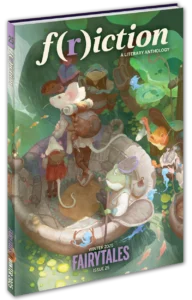
My Mother is the Water
Words By Lyndsie Manusos, Art By Koby Griggs
My aunt wants me to avoid the water’s edge for fear I might swim away as my mother did. Soon, I plan to. There’s a brittle fence between me and the water; two wires at the top and middle of the wood posts connecting them. It is not a prison, but the shoreline is a wish. A hope. A plan.
My aunt has no children of her own. She never fell in love, keeping mostly to the small island and lake cottage on which we live. She took fierce ownership of me when my mother disappeared.
She waded in and off she went, my aunt said. Our mother—your grandmother—knew it would happen. It was only a matter of time. She had Papa take down the fence after she was born. They saw her gills… the size of them…
My aunt often trails off at the mention of the gills, her eyes glazed with memory.
Well not you, my love. Not you.
Every time we speak of my mother, my aunt crows, her loss is my gain! She looks me over, mouth slightly open as if she might swallow me whole.
My gills are bigger than my mother’s.
I don’t remember much about my mother—she left when I was barely walking—but I know of her gills. Because my aunt looks in my eyes each day and her gaze drips down to my throat and holds. Ah, there. Sees the skin arc away, revealing red flesh beneath. My gills work like an itch, sting when they are too dry, and gulp down raw air. As such, they don’t work as they should, not unless I am submerged in a tub of water.
Sometimes my aunt stares at my gills until I speak her name, or fidget, or touch the place where she stares, and then she shakes her head. I see her touch her own throat with her fingers, each knuckle a thick knot of skin, full of calluses from mending nets, hooking worms.
Years ago, I watched her fingers slip (a rare occurrence) and the hook pierced her thumb, straight through the nail. I yelped and reached for her, but she elbowed me away. Gritting her teeth, I watched her push the hook through and out the other end. That way, the barb would not take more skin coming out. Then she put her thumb in her mouth and sucked.
Beautiful scars and knots.
Often now, she touches her fingers to her throat and feels sagging skin. I believe she hates my mother for that omission. My aunt often said my mother was the pride of their parents because of her gills. Lake people found it a blessing, to be touched by the legends of old.
Your mother seemed born right out of the Dinah fairy tales, my aunt told me once. And doesn’t every child want to be told such things?
My aunt was therefore looked upon as disappointingly… normal. So yes, my aunt loved her sister. Still loves her. Misses her in all ways: the way my mother made the perfect cup of tea, the way she sang… But yes, I think some part of my aunt still hates her as well.
She will likely hate me, too, when I leave.

My aunt says the Dinah Lakes are as sprawling as the Far-off Sea.
Tell me a story of the sea, I asked my aunt as a child. I’ve never seen the sea. A single, endless body of water still sounds ridiculous to me; the Dinah Lakes are their own endlessness. There is always a lake to come upon, and then usually an island or peninsula that connects to the mainland, and then another lake. There are rivers and creeks that link lakes to bays, bays to channels. The veins and organs of a vast goddess. And we lake people worship each bit of this chain.
Instead of the sea, I now beg my aunt to repeat the old tales of the lakes. Each night before bed, when the fire burns low, I ask her. And this night is no different. My aunt mends her nets or sews clothes while she sits near the hearth. I listen from the comfort of the tub, the water up to my chin as I crouch in it. It has long gone cold, but I don’t mind. My skin feels smooth and lush, plump with moisture. My aunt occasionally looks up from her work, gazes out the window, and tells the tales in a forlorn voice.
When Dinah’s water broke, it became the lakes, and then she birthed the land that separated them. For a long time, Dinah was happy. Her lands and the lakes were beautiful. She made fish to swim in them, trees to grow on the small islands. But she became lonely. The sun would not speak to her, and the moon only sighed in silence. Dinah cried, and her tears made the lake people.
She pauses at this part and eyes me. As a child, I used to clap my hands and say, The tears became me.
Perhaps, my aunt nodded, going back to her sewing, her mending.
I stopped saying those words after I realized how it sounded to her.
So, the tears became the lake people. And there was an age when they could swim from the edge of one lake to another without drawing a single breath. So strong was the essence of Dinah within them. There was no need for boats or rafts. They pushed off a soft shore and rose up out of a stone seawall miles away or climbed up the rafters of a rickety bridge.
They had scales for skin that matched the colors of the lake water. Tea green. Amber-tinged brown. With eyes a bit too wide and mouths a bit too large, my aunt says. Some believe the lake people used to swallow fish whole, or even people.
I often make a funny face to reenact the eating and swallowing of something big. I’d hold my belly and make a noise of content. My aunt often laughed. Sometimes she threw a piece of boiled crabapple at me, and I chomped that down until pulp leaked from my teeth.
How ravenous you are, my aunt grins. Then, her voice dips low.
There were also those with gills. Gills that sought to gulp down fresh water and steal the very air from it.
Here we pause and think our separate thoughts. My aunt begins to squint as she mends, so she sets it aside and begins to put the cottage to rights before we go to sleep.
I stay in the tub as long as possible, knowing my aunt will ask me to get out soon. It is an awkward moment for both of us. Her hoping I am content with what I’ve had, and me knowing I will never be content. While she unfolds blankets, and beats pillows to softness, I think of my mother.
She was one of them, the pride of her family. But if my mother was beloved by the lakes, what does that make my aunt? She who kisses each fish she catches, lips to scales, and bows her head to the Dinah in thanks for its bounty? She who bears scars to show years of wear?
These are my thoughts as I stand by the water the following morning, fingering the wire of the fence. I watch a beaver kick up to the shoreline, ambling onto the wet grass. It has a limp in its hind leg, a gash, perhaps from a predator or a hunter seeking meat. As the beaver trudges around, it seems to be looking for something in the grass. It slaps at the ground with its digitated front paw until it cups something—what looks like a pebble— and puts it in its mouth. Whatever the beaver ingests seems to lift its spirits, because it puts the injured hind leg down again and bounces on it. I smile at the sight.
I’m about to coax the beaver to me, wanting a closer look at its injury and repair, but then I hear a kettle placed on the hearth. I run back to the cottage, which stands directly in the middle of our small island, slightly uphill to avoid flooding. It is a beacon of sorts, the first house for miles that many see in the open, with only a few small crabapple trees that produce fruit as knotted as my aunt’s fingers. The apples are only good for soaking in hot water and sugar.
I run back to climb through the window of my room before my aunt notices I am gone.

A week later, at the brightest burn of summer, I see a bluegill swimming beyond the shoreline, and my heart leaps at the sight of it. The two wires in the fence frame it perfectly, swimming in a circle where the grass underwater turns to mud. The scales shine against the sunrise, winking at me.
It is our guardian fish of the Dinah Lakes. Despite its name, it is green, with either a yellow or red belly. A narrow, efficient fish, and lake people tend to avoid eating it unless absolutely necessary. It is said a sign of a bluegill portents good fortune, and as it swims in its soft circle, I hope the fortune becomes my own. I inhale, but it catches in my throat, and I cough. My throat feels drier this morning, like char from the hearth. The skin on my nose is starting to peel. My cheeks are raw. When my aunt sees these signs, she sucks on her bottom lip and fills the tub with lake water. Then I am allowed to dunk for a few hours, hugging my knees to my chest. Hear her stories. My gills stretch and sigh. I relax. When I emerge, she waits with a towel, glowing and content to see my skin flush and supple again. Any injuries, blemishes, or pain are gone.
There, she says. All you need. A few minutes of dunking and you’re right as rain.
Right as rain. Right as tears.
I know she wishes that were true.

Each morning, I like to greet the sun and stare at the water, soaking it in, remembering that I was born at sunrise. My aunt said that’s how my mother came to name me Sunny.
Sunny is also a common name for the bluegill.
After the first sighting, the bluegill returns each morning, swimming to the same spot right as I get to the fence, breathless with anticipation. After the third day, I crouch in the grass, my bare feet sinking a little. There was rain last week, and the water’s edge is soggy like a wet cloth.
I hold out my hand.
Come, I whisper.
The bluegill moves closer. Avoiding a large rock as the lake bottom slopes upward toward the fence. I huff a laugh.
Come, I whisper again.
It swims closer still.
I do not remember my mother, but my aunt says my mother used to speak to the water for days before she left. Perhaps it wasn’t only to the water.
Come, I whisper.
It does.
By now, the bluegill is as close as possible without its fins breaching the surface. It’s only about a foot long. Black stripes gash down its side against the green scales. It swims in a tiny circle, and I see its belly is yellow, almost golden. A female.
With a dip, the bluegill arches out of the water, jumping, and from its mouth, a pebble. It falls at my feet. Nearly a perfect sphere, polished in the gullet of this beautiful fish. It’s green and brown and blue. I remember the beaver finding a pebble in the soggy grass near the shore. Eating it. Placing its weight back on the injured leg. I stomp my own foot into the ground, a wet splash of mud, grass, and water. I stomp the other foot, a giggle gurgling up my throat, which I tamp down to avoid my aunt hearing. Dinah has blessed me with this pebble. How exactly, I do not know, but there’s a path now.
I pocket it in my nightdress and the stone feels warm against my skin.
The whistle of the kettle over the hearth summons me back. My aunt is awake, and I walk to the other side of the cottage to climb back into the window of my bedroom. I hear her footsteps coming as I crawl into bed, putting the covers over my feet so she doesn’t see strands of grass and clumps of mud.
I rub my eyes as she opens the door. She stands in the doorway for a moment, taking me in. My hair is frazzled, and she no doubt notices the skin peeling from the slope of my nose.
A tub today, she says. She sounds defeated. I had a tub yesterday. It used to be every other day, and before that, once a week. When I was a child, maybe once a month, unless my messiness required it. Time is tightening on her, and I see it in the hollowness of her cheeks.
I’m sorry, I say. I don’t mean to.
She sighs. We cannot be anything but what we are.
She walks fully into the room, places a cup of tea on the bedside table. Then she cradles my face in her hands, feels my nose with her thumb. The scar from the fishing hook bumps along my own skin, and I shiver at the affection of her touch. My aunt is not my mother, but she is also my mother. Her hugs cradled me when I was injured from twisting my ankle or from cutting my hand as I reverently cleaned an edible fish. A year ago, she held me up with strong shoulders when I sobbed over the body of a dead sea snake found on our shore. The snake matched the blue of the sky, and it held a snake egg in its mouth, red as a jewel. There were teeth marks slashed among the blue scales, dripping with blood.
Land wolves, my aunt had said gravely. This snake has traveled far indeed. From a place where everything eats, and there is no contentment, no satisfaction, no healing. Only hunger.
Land.
Not the land of the tiny lake island we lived on, or the thin shores we see across the lake, or the lakes on the other side of those small lake islands. As a child, my aunt took a book from underneath her bed and handed it to me. An atlas of the Wide World. Land unbaptized by lakes and rivers, as big as the ocean, I read. I never want to go there.
My aunt wouldn’t want me to go anyway, I knew. She would keep me on this island, with her, if she could. In that, I was content. Except for the call of the water.
My aunt continues to cradle my face, and we stare at one another. Her eyes are hazel like mine, whereas my mother’s were blue. We all have the same hue of hair, brown as the lake mud, black when wet.
She looks up and out the window above my bed, seeing the pane open, the hot breeze coming in. Her gaze snags on the water’s edge, seeing the fence there.
One day, I shall be alone, she says.
My aunt lets go of my face and walks away. Her shoulders shake. I reach for her but miss her skirts, feeling the breeze of them waft away.
Another day of mending nets and fishing.
My aunt puts a small bucket of lake water on the front step of our cottage for me to place my feet in as I patch a hole. At noon, the sun is high and hot, and a boat appears from around the bend of the island to the east and heads our way.
Not local, my aunt says glancing at its shape.
Most boats from the Dinah Lakes are made from leftover wood, scrap metal, or cloth. This boat is bigger, streamlined and polished. It has two metal pontoons on each side to allow it to skim across the shallow waters. Two people row with long paddles on each side, but there is a lowered sail no doubt used for the bigger lakes. It’s not strange to see a boat, even one as big as this. This is how lake people make a living. Boats appear, we trade, and the boats disappear again. Sometimes the people on the boats are not lake people. They come from afar, and what they trade is otherworldly and special. A book. A red wax candle. Spices with a strange taste. Clothes that are much too heavy even for our coldest season. Sometimes those trading are not mere traders but travelers. Many have claimed that they are attempting to catalog and map each lake, and my aunt and I both stifle our laughs at such a ludicrous attempt.
There is a certain smell to ones who perform magic, as if their clothes are singed at the hem. The wielders seem too dry, their hands too big. Usually, the fire throwers notice my gills and react in earnest. Their mouths drop, eyes widen. They stare at me with a kind of longing.
Can you master the water, they ask. Does it bend to your will?
I would be very useful to their masters if that were the case. But I assure them I am merely part of the lakes. No more powerful outside our land than a fish out of water. My aunt usually clutches my shoulder when I explain this to them, perhaps in fear that at any moment I might change my mind and go with them.
My aunt watches the boat loom closer. Her hands move swiftly as she threads a new fishing hook to a line. It is a larger hook, as big as my palm. There are much bigger fish in the Dinah Lakes than bluegill. Moon Sturgeon can grow to twenty feet long—though they are rare—or the Far-off Perch, named for being brought here centuries ago. It would’ve eaten the rest of our fish to extinction if the Sturgeon didn’t hunt it in the moonlight. Luckily, Far-off Perch makes for feastful eating, and my aunt is known among the lakes for her ability to catch them with little effort. She has an arm like an arrow, whipping the fishing line. The hook is fast and goes long, and in a heartbeat, she’ll reel in a fish.
The boat nears, and I drop the net and step out of the bucket to walk with my aunt to the shoreline. I rest my palms on a post of the fence.
The two rowers drop their paddles as they near shore, letting the momentum carry the pontoon until it rises up onto the muddy shoreline. I eye the metal of the pontoons; scraps welded together like a puzzle. The boat is ramshackle but impressive.
The rowers hop off, landing knee-deep in water. They wear patchwork trousers, shirts too thick for the weather. Yes, they’ve come far.
You’re the first we’ve seen in days, one says.
They walk up the shoreline until they are a few feet from us. The fence separates us, but it is a poor shield.
My aunt’s eyes narrow and her hand tightens on the fishing line tied to the hook. I clutch the post until my nails dig into the wood.
Most lake people know how to keep scarce, if need be, by either wading deep into the water, swimming quickly to another shore (though not with one breath as in the legends), or by merely not answering when those from afar call upon them. If these strangers have not come upon anyone for miles, it’s because the lake people didn’t want to be found.
I inhale and smell the reason why.
Rather than a small singe, these newcomers smell powerful, like an oil lamp that has burned for days. Overused.
I move to cover my throat with my hands. I should’ve worn a scarf or tied a ribbon there. But the days have been hot and humid; any bit of cloth is suffocating.
My movements are sluggish, and one of the men turns to me, sees what I am covering before my fingers clamp over it.
Oh… good, the magician says. The legends are true.
They share a glance. The other one smiles.
You will make a fine show indeed.
I turn to my aunt, breathing hard enough that my gills stand on end, like blades of grass in the wind. It stings, and I gulp so loud the magicians laugh.
There’s a reason I turn to her. A reason why she clutches the hook. Whip-quick, she hauls back her arm, using the hook’s weight to aim.
The hook flies over the fence and catches the first in the throat, where gills might be if he had any. His eyes bulge. The other rears back his hand to throw as well, but instead of a weapon, fire roars forth, wrapping around my aunt’s tunic. The flames rise quickly, even in the humidity.
I scream, fool that I am. Scream and fall back onto the wet grass. The magician wielding fire kneels, reaching between the wires to grab at my ankles. I scramble back as I see the same hook catch him around the throat as well. The first magician is face down in the water now, blood pooling around him.
The second magician seems surprised, shock blanketing the agony. His mouth moves, like a fish in water. Like my aunt’s thumb, there would be less blood if it were pushed all the way through.
But my aunt hurls back with a grunt. Relentless.
The hook takes with it more flesh, and soon enough the magician’s throat is gone. He, too, falls into the lake water, tainting it red.
Silence.
I turn toward my aunt and scream again. She lays on the grass, limbs shaking. Her tunic smokes and disintegrates, and below the remaining cloth is raw flesh, spiraling into blisters. The burns end beneath her breasts.
She clutches the hook in her hand, dripping and coated with tissue. She holds it to her chest like a talisman.
Sunny, she says, breathless. Water. Ointment.
I scramble to my feet and run for a bucket in the cottage. Bandages. The jar of ointment that we have on hand is large, but the ointment is nearly gone, used over months and months when we burned our hands on the hearth or when our skin reddened under the sun. We weren’t expecting traders to bring a new jar for another few days at least.
I stare at the jar in a sort of wonder, having never come across this feeling before.
It is not enough. It is not enough.
Somehow, I manage to carry my aunt into the cottage, leaving the bodies on the shoreline.
It feels wrong to let their blood pollute the Dinah Lakes, but perhaps we will get lucky; a Moon Sturgeon might arrive in the night and take them, swallow them whole. It would not be the first nor last time a fish has feasted on the dead.
I use the ointment until there is none left, and still much of my aunt’s body is burnt. Like the hook in her thumb, my aunt does not cry out or wail, but instead grits her teeth. Spit drips from her mouth. Tears fall down her cheeks. I almost wish she would wail, because this bottling of pain seems worse, and I know it will only last so long.
Some of her tunic is stuck to her skin. I rip and cut around to take off what I can. My hands shake as I do, but I stay busy. Meticulous. I start a bowl of soup by boiling lake water over the hearth. I turn to walk past my aunt to grab a ceramic bowl and startle as her fingers touch my ankle.
Sunny, she says, you must rest.
There is much to do.
A moment, my love, she says.
I stare at her drawn face. Her fingers tremble as they clamp around my ankle. I should bring her to my room but fear the mattress may stick to her wounds. Her own cot is merely feet away, but she’d collapsed when we walked in.
She should not stay on the floor. She shouldn’t be here at all.
Sunny, she says, your thoughts are loud.
I am a coward, Aunt.
No, she says, I have no regrets for what I have done. My only regret is that I am going first.
Going, I wonder. Going where?
The realization crashes on me like a whitecap in a storm. All this talk that I may swim off as my mother had, that I may wade in one day and my aunt would wake and find me gone.
Her biggest fear and yet…
And yet.
Aunt, I say, my voice like a child’s again.
Tell me a story.
She doesn’t heed me. She only gives my ankle a soft squeeze.
It is all right, my love, my aunt says. It will be all right.

She begins to wane. Her breathing becomes dry and hard, the burns make her vibrate with pain. She tries not to show it, but I feel it in the way her teeth chatter, taste the sweat that seems to levitate off her in the humidity.
While she sleeps for a brief moment—exhaustion winning out over the pain—I go to my own bed and cry into my pillow, writhe among the sheets. I clutch my dress, wrenching at the cloth, hating it, hating anything that seems soft. It is there I find the pebble. I remember the bluegill, swimming close, answering my calls.
A perfect sphere. A tiny world in my palm. It is still warm, either from the hot summer day, my sweaty palms… or perhaps something else.
I bring the pebble to my lips. Lick the rough surface. It tastes of the Dinah Lakes, fresh water and its abundance of seaweed and gelatinous mud. My gills stretch out on my throat at the taste. I feel lightheaded.
I remember the beaver, and my feet stomping in the wet grass. Oh, I could take that path now, right now, and know my aunt would watch and do nothing. Could do nothing. She’d always said she was of the island. She’d die here, and her last thoughts would be of acceptance. Forgiveness. Of that I was certain. A burning sensation flooded my chest at the thought, like the smell of the magicians. A wrongness. Instead, I heard my aunt’s voice, the memories of her knotted thumbs on my skin.
Tell me a story.
We cannot be anything but what we are. One day, I shall be alone.
Dinah cried, and her tears became the lake people. And the tears became me.
I clutch the pebble in one hand while my fingers trace a trail of wetness from my eyes to the slits on my throat; my gills lap at the grief, and I know I cannot leave her.
Perhaps…
I get out of bed and open the door back into the main room of the cottage, see my aunt on the floor. Her chest spasms. The room smells sweet of blood and burnt skin. I tiptoe in, kneel next to her. My aunt’s mouth is slightly open. Each breath like a cracked branch.
I hold the pebble over her lips and lower it to her tongue. I watch it roll to the back of her throat and gently lift her chin to close her mouth.
Her eyes open as I see her throat move, adjust to it. She does not struggle.
Forgive me, I say, as she gulps. I don’t know what else to do.
Her eyes hold mine, and she says nothing. Not even after I see her swallow the pebble, and
I imagine it landing with a thud in her stomach. Her eyes widen, eyelids fluttering against the pain racking her body. Her mouth remains closed even as I let go of her chin and retreat back into my room.
She is alive in the morning. Alive and not in quite as much agony. As I walk in the room and kneel at her side, she turns to me, biting her lip.
What did you do?
I shrug. The Dinah gave me a token. I hoped it might save you.
My aunt sighs, a smooth dip of her chest. No longer as close to death.
When did this happen?
Yesterday.
And how did you come by this token?
A bluegill.
My aunt nods, as if this makes sense, though she says, Do not waste such gifts on me. I open my mouth to object, but she holds up a hand. The skin on her fingers is still blistered and red, but I notice where the skin was once broken and bloody has healed. Her lips, also, are no longer chapped. And the stench of baked skin, of flesh made wrong, is less.
I reach out and clasp her hand. I inspect her fingers. Not only is she healing, but her hands are smaller. Fingers that were once longer and gnarled, able to envelope my own, are now tinier. Dainty, though not a child’s hands; the age remains.
I take in the space around her. There is a stain of blood on the ground where her feet used to be. Not younger. Merely a shade shorter.
Aunt, I say, swallowing my awe. How do you feel?
She tilts her head, and that’s when I think she realizes that something is different. Something is not the same.
I feel–
She inhales, looks about the room. At our cottage. We both startle as rain begins to fall outside, pelting the window. The smell of the Dinah Lakes, moist and earthy, seeps into the room.
Like I’m waiting, she says and seems surprised with herself. Like the Dinah’s tears, and I am glad of it. She smiles. I am glad.
We inhale the air together, and my gills stretch with the taste of water.
Before my aunt wakes the next morning, I go back to the waterline and wait by the fence.
The bodies are gone. Miracles must be with us, for the Moon Sturgeon have lived up to their name and appetite, taking the magicians away in the night. The boat floats away in the distance. A small shame, I think, as I should’ve seen what supplies were to be found, though I don’t doubt in a few days’ time, the lake people will converge upon and dismantle it. Soon there will be no trace of them ever having been here.
Good. Woe to those who come to the lakes seeking to claim what is not theirs.
A ripple in the water beyond the shore catches my eye and I see a flash of a golden belly.
The bluegill has returned.
I felt it this morning as I awoke, a tug back to the same spot on our island. Already, my nose peels again, and my cheeks are like dry leaves during a drought. I went back to the shoreline, stood in the same spot as the warmth of the soggy grass and mud hugged my toes. The same heaviness filled my chest, stretching my gills.
The very sight of her makes me teary-eyed. It is such a relief to see the familiar gashes down the side, the color of her belly.
I kneel on the ground, clutch the bottom wire of the fence.
Come, I say.
The bluegill listens.
I laugh aloud, my gills standing on end, gulping the humid air. I wave the bluegill, closer, closer.
Come, I say. Please.
Again, she does. And like the previous visit, she reaches a point where she cannot go farther. She swims in a circle, gaining momentum, and leaps.
Another pebble flings from her gullet and lands at my feet.
I don’t even think, do not stop to wonder or guess. I scoop it up with my palm along with some muddy lake water and devour it whole.
It rolls down my throat, and I feel it plop into my stomach, settle there.
Perhaps it will heal my peeling skin or let me go a little while longer without a bath. Perhaps it will help me heal my aunt further, even as she begins to shrink.
The hope sits in my stomach with the pebble, and I wave to the bluegill as it turns around and swims away. There’s a flash of gold from the rising sun on its belly—a wink—and then it is gone.
When I return to the cottage, my aunt is smaller.
She looks herself, and her burns have healed at an even faster rate. She is neither younger nor older. The scar on her thumb from the hook remains, though it’s smoother, a bit softer. Her breaths are deep and content as she sleeps on the floor, and I am able to scoop her into my arms like a child and carry her to my bed. My aunt doesn’t stir as I tuck her in, minding the parts of the blanket that are dirty from my past trips to the shoreline in the middle of the night or early morning.
When I think she’s settled, I go back to the main room and begin to clean away the blood. I take a wet rag to the floorboards. I carry the bucket of water I used to clean her wounds to the shoreline and pour the pinkish water out. A slew of fish arrive—catfish, perch—and gulp it down.
Yes, I say to them, clean her, consume her.
I return to the cottage and begin to organize our things. I wash the hearth of ashes, fold any blankets or unused rags, clean any dishes. There’s a pitcher of cold tea from the day before, and I gulp it from the rim until it’s empty. Smack my lips together. My bones ache in a way I’ve never felt before, a growth or the shedding of skin. I touch my gills and let my fingertips bounce over the edges. There’s an itch at the base of my neck and my fingers travel there, only to discover a patch of something smooth and bumpy.
Scales.
I drop the pitcher in my other hand and find a mirror. It’s hard to see with where they are on my neck, but when I bend my head, there: scales, indeed. Silvery green and glorious. I gasp, then laugh.
When my aunt comes out of my bedroom, she’s only a couple of feet tall but still herself. Her clothes are now draped around her like an old wedding gown.
Sunny, she says, what is it?
I turn my head to present the back of my neck to her. Since discovering them, there are already more, travelling in a patch down the ridges of my spine. My bones ache, but it feels good. I hold a hand up in front of my face. Webbing sews itself together between my fingers.
I am breathless. I am relieved.
My aunt stands next to me and taps my hip, so I kneel to her level. She puts a hand on the scales and slides her tiny fingers down.
There was a time I feared this, she says, and it kept me awake at night. All the way until morning, when I heard you climb from your window to go to the water’s edge.
She waves her free hand, and I see the burns are nearly fully healed.
And now? I ask.
Her fingers stop as they hit the collar of my summer dress, though we both know the scales continue down, down, down.
The same as yesterday, she says. I welcome it. She takes my hand. Are you ready?
I nod. We both clean the rest of the cottage, leaving it spotless.

Within a day, the scales multiply. My aunt continues her descent. Soon she is to my knees, then to my shins. I begin to grow smaller as well, following her to ground. Soon, I cannot lift a cup to my lips—the webbing grows, and my fingers turn into membranes of bone and skin—my aunt uses both her tiny hands to carry a cup and pour it over my body. It doesn’t need to go in my mouth, though I am constantly parched. My gills clamor for air.
By sunset, my aunt is dragging me by the tail fin toward the water’s edge. My eyelids fall off, as does my hair. I curl into a ball, and my skin morphs, distends.
It takes hours but soon we are of similar size, though different shapes. My aunt’s fingers slip against my skin, and she has to reach into my gills and tug me there. It stings but a little.
My aunt ducks under the bottom fence wire and we wade into the water.
Dinah, my aunt says, Can you hear her, my love? I never knew. The water is like a song.
I can no longer answer. My mouth is a singular shape, gulping, screaming, and I can no longer nod. The Dinah Lakes have always sounded that way to me, and now it seems to finally beckon us both.
The moon rises.
The water looks silver, and in the light peeking through the clouds, I see another wink of light among the water ahead of us. The gold flash of a belly. She has come for the third time. The bluegill, my aunt says, leaning against my flat, scaled side. She holds me still with what weight she has left, though I ache to jerk and swim forth, to use the fins that now protrude from my body.
My aunt turns to me, looks me over. I am larger than the bluegill. Something different altogether, perhaps, though judging by how my scales seem to glisten in the moonlight, the width of my gullet, my hunger, I think I have become something akin to a Moon Sturgeon.
My aunt seems to realize this, and she smiles.
Like the tales of old, she says, then she seems to shrink even more, until she is barely a finger high. The water from the shoreline comes up to her shoulders, and she moves to stand in front of me.
I am ready, she says.
As with the pebble, I do not wait. Do not ponder. I leap forward, tail thrashing, my gullet open. I swallow my aunt along with a handful of lake water. She stops moving. No longer what she was but what she is.
My gills soak in water. My tail moves. My scales shine.
Tell me a story, my aunt says, her voice a vibration along my spine. About the lake people. I begin as I follow the bluegill with the golden belly.
Once upon a time.
Out, out, out we go.
My aunt settles in my stomach, content as the pebble, and just as warm.