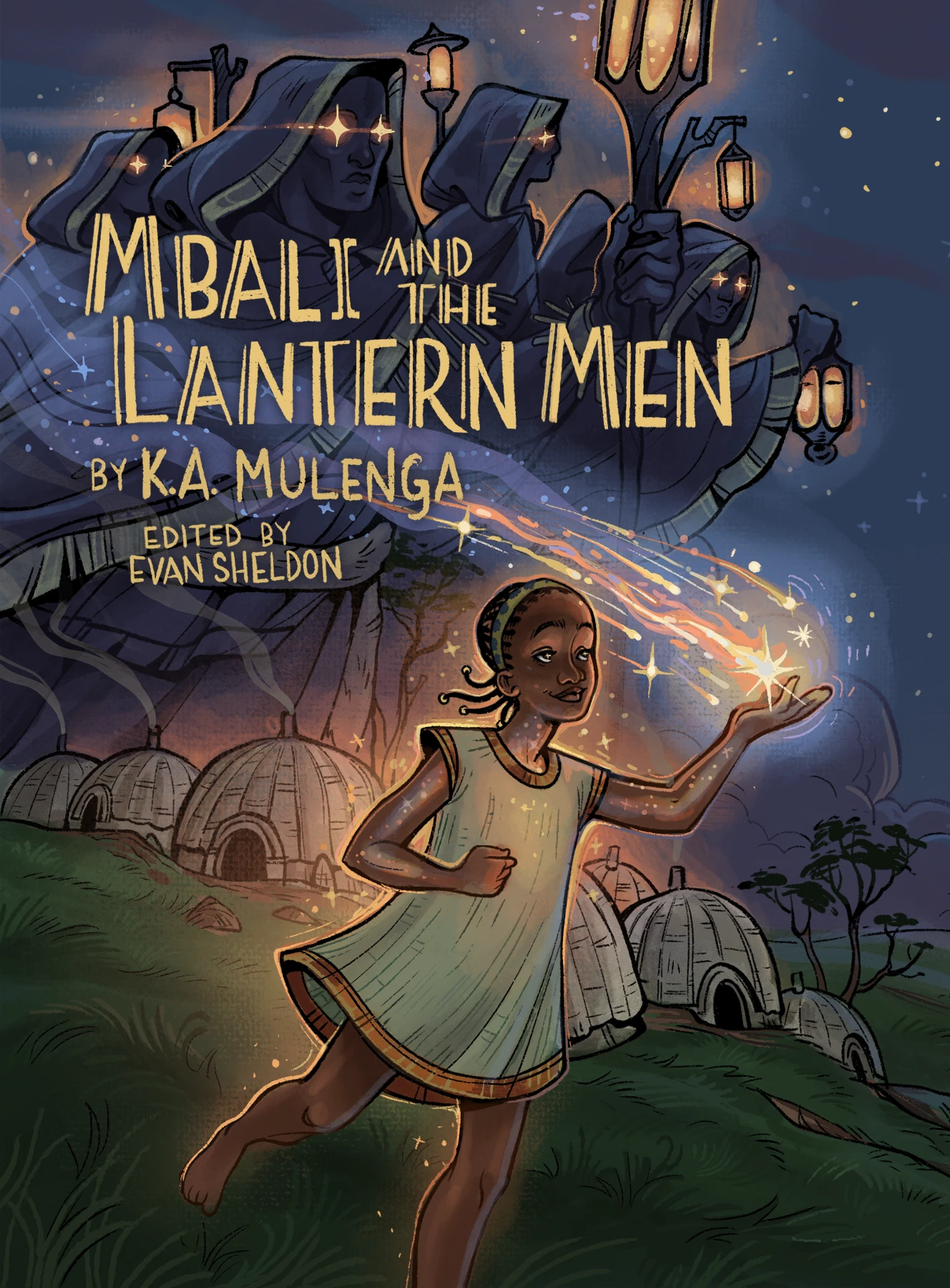
Mbali and the Lantern Men
Words By K. A. Mulenga, Art By Isabel Burke
The first time Mbali swallowed a star, she was five years old. It shimmered above her, small and flickering like an ember dropped from the sky. She thought it was candy. When she opened her mouth, it tumbled down her throat, leaving a trail of silver in its wake. That night the elders squinted at the sky, muttering that a star had disappeared.
“The heavens shift,” they would say. But no one knew where the star had gone.
It burned—not with pain, but with warmth, seeping through her like honey poured into cold hands. It made her feel whole, if only for a moment.
Afterward, a light blossomed beneath her skin.
Her mother called it a fever. Her father lit candles in the church. Her older sister, Lerato, covered Mbali’s hands in mittens so no one would see the light leaking from her fingertips.
“People don’t like things that shine too much,” Lerato whispered. “They get jealous. And when they do, the lantern men come to take the light away.”
But Mbali couldn’t stop. It wasn’t just hunger—something deeper, something ancient and unshakable. No matter how much she ate or how full she was, there was always an emptiness, a space inside her only starlight could fill. Sometimes, when the village was quiet and the stars were slow to appear, she wondered what it would mean to stop. To stay. Could she learn to live with her light dimmed, if it meant holding on to those she loved?
She climbed the tallest trees, perched on the thatched huts, and waded deep into the lake where the water swallowed the moon. Every night, she tilted her head back and drank the sky. As the stars dissolved within her, her skin shimmered like river water at dawn, her breath sparkled in the cool night air, and the glow within her deepened. And every night, she grew brighter—her veins shimmered, her voice hummed like constellations colliding.
The years passed, and Mbali’s glow only grew stronger. What had started as a flicker beneath her skin had become something undeniable—a light too bright to be hidden beneath blankets or behind closed doors. She was no longer a child, but something on the cusp of becoming.
She had learned to love her village despite this difference. She sat by the fire with Lerato, listening to the elders tell stories. The scent of woodsmoke clung to her skin, and the laughter of the children rang through the night. She loved this place—its warmth, its rhythm, the way it held her like an old song. But with every star swallowed, she felt herself slipping further away.
Then came the lantern men.
They arrived in the village at dusk, their cloaks heavy with soot, their boots crunching frost into glass. They carried lanterns, but they didn’t need them; their eyes burned with stolen light. Whispers rippled through the village, hushed and urgent. Mothers pulled their children closer; elders turned their faces away. “They have come to take her,” someone murmured. “To snuff her light and trap it in their lanterns.”
Lerato’s grip on Mbali’s hand tightened. Her palm was damp, her breath uneven. “Don’t go,” she whispered, but her voice trembled—not just with sadness, but with something close to fear.
The tallest leaned down to Mbali, sniffing the air like a wolf. “We have seen your light,” he said, voice flickering like a candle about to go out. “And now, you must come.”
“I don’t want to be like you,” Mbali said, though the words felt untrue.
“We did not choose this, but we will guide you.”
She could stay. She could stop swallowing stars, bury herself in the warmth of the village, and pretend she was not made of something else. She imagined Lerato’s arms around her, the crackle of firewood, the laughter of the children echoing through the night. But even as the thought entered her mind, she knew that her bones were already full of light.
To stay would be to shrink. She would not dim herself now.
“You did not make my light,” she said, her voice steady now. “I chose it.”
And so, she stepped forward.
Beyond the village, beyond the last stretch of trees, there was only darkness—the kind that swallowed sound, that shimmered with distant, flickering lights. It was not a place of suffering but of stillness, of passing. A place where lost things went to become something else.
Mbali did not know what she would find there. Perhaps she would burn brighter than ever. Perhaps she would disappear into the dark.
As she left her home, she swallowed one last star. Light pulsed through her, brilliant and endless. And as she walked into the dark, she did not vanish. She burned bright.