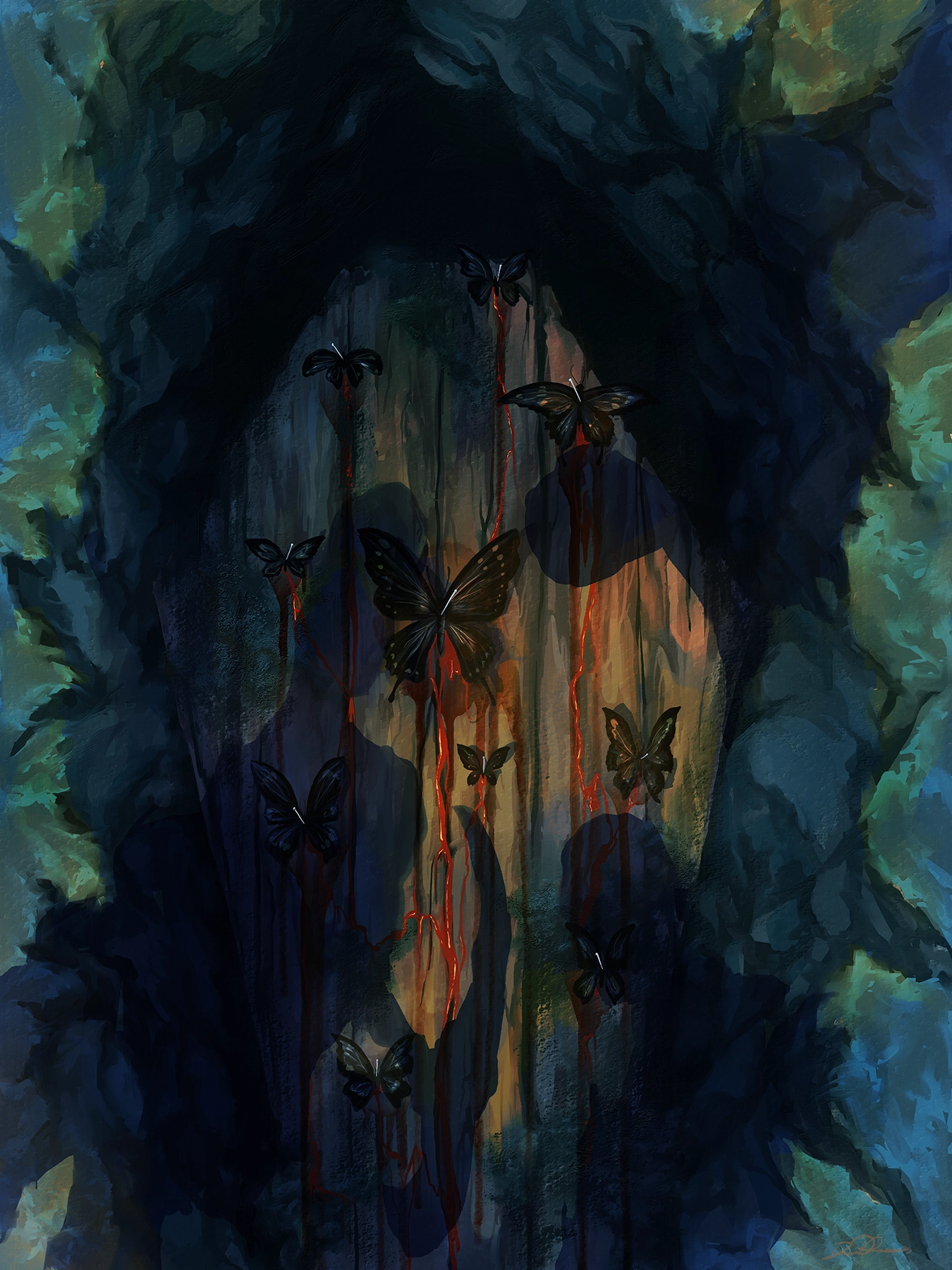
Black Butterfly
Words By Noah Charney and Svetlana Slapšak, Art By Daniel Reneau
As the clubs and hoes and threshers and rakes hailed down upon him, and the last of his breath was bludgeoned from his body, his mouth gaped open a final time and into it flew a black butterfly.
Sava Savanović was dead.
For now.
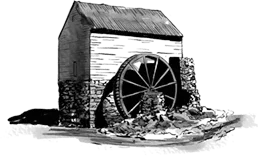
In a rural part of Serbia, quite far from the road between Bajina Bašta and Valjevo, along the serpentine route of the river Rogačica, there lies a village called Zarožje. A short walk from this village stands a birch forest that drops down sharply into a ravine. Within this fog-bound vale sits, or perhaps it would be better to say dwells, a watermill. It is cold even on the hottest summer day and in shadow even when the sun shines brightest. The vale is clotted with thick forest, tumbled boulders and a switchback stream that torques its way painfully through the vale’s lowest point. This vein at the foot of the vale pushes a half-rotting waterwheel that, in fairer times, would grind grain for flour for the village of Zarožje—a scattering of farmhouses at the top of the hill—in one direction, and the village of Ovčina at the top of the hill in the other. There the black hawthorn grows. In summer, when it is smothered in white blossoms like snow, its scent summons butterflies by the hundreds. In winter, its bare, skeletal branches are speckled with red berries, each round and swollen like puncture wounds bubbling blood.
The stream gurgles its way around jagged rocks that cause whirlpools to form where they should not. By night, the vale is pitch black and pierced only by cries: of nightjars and owls and the occasional distant wolf, for not even wolves dare to enter the vale. The watermill is made of stones at its base, but their angles are awry, as if the stones themselves wish to move away from the site, each in their own direction. The upper story is made of wood long rotted. Inside, the grindstones lie in wait, the hearthstone is cracked, and the loft above, once optimistically built to hold all the grain that would be milled here, is home to no man. Yet there is still a strange congregation that gives the illusion of life to this long-abandoned, still longer godforsaken mill. For the ceiling inside, rotten and pocked with holes though it is, is covered, all the year round, in a thick and moving carpet of all-black creatures.
Butterflies.
Before the mill fell into abandonment—when there was still the hope, indeed the need, for it to grind grain for the villages of Zarožje and Ovčina—it played a key role in the second killing of Sava Savanović.
The villagers of Ovčina liked to say that the villagers of Zarožje shoveled walnuts with a pitchfork, watered their willow trees and sowed their fields with salt. The folk from Zarožje said that the folk from Ovčina stretched out their wooden boards, carried hot coals by hand and would go into the forest with an axe when they ran out of toothpicks. The leaders of each village, the kmet, were somehow related (they were not sure exactly how), but this did not improve their relations. The two villages were so busy either arguing with or ignoring one another that, over the course of three generations, the story of Sava Savanović was forgotten. Only one person in the village had been alive when, ninety years earlier, Sava Savanović had been killed, or as killed as a future vampire can reasonably be. Aunt Mirjana was a century old, more or less, but now she was rather less aware than more, as she was blind and almost completely deaf. She had raised children, grandchildren, nieces and nephews, great-nieces and great-nephews, and possibly some random kids who’d shown up at her door. One of her brood was a young man, just at the cusp of adulthood, named Strahinja.
He had no immediate family, so she had raised him until the first crocuses of his beard showed, at which point he set out to earn his living. He apprenticed himself to a group of men from Ovčina, on the other side of the vale from his Aunt Mirjana. They were master carpenters who traveled as far away as Belgrade to build houses for the wealthy inhabitants. Strahinja learned the trade and journeyed with them, becoming like a young brother to them. And though he endured many a joke at the expense of his origins in Zarožje, they developed a great affection for Strahinja and helped him to become a man.
When he returned to Zarožje, Strahinja set to work on his one inheritance: a ruined hut on the far edge of the village, a bit too close to the forested vale for the tastes of locals. Since it was all he had, he committed himself to working it back into a livable state. Inspired by the folk who live around the Sava River, and encouraged by his fellow carpenters and masons, he had adopted the habit of smoking a clay pipe, which the locals considered odd for a boy so young.
Now when Strahinja returned and was working on his hut, his eye was drawn to the daughter of the kmet of Zarožje, Radojka. Her face was fresh and beautiful, bright and soft, her hair flaxen and her skin milk white. She returned his affection. Her father did not. Živan Dušman was in charge of the village, as had been his great-grandfather and so on, many generations past. He was quick and eager to anger. His belly shook and his moustache bristled. They said of him that he liked fighting as much as he liked rakija, and he was a man who liked rakija. He was the most important man in Zarožje and wanted his only daughter to marry someone of similar prominence. He was unimpressed by Strahinja, by his run-down hut, by his questionable travels in questionable company, by his weird pipe-smoking.
Eventually he forbade Radojka from seeing Strahinja. Any time she mentioned Strahinja, Živan Dušman would shout and slam his oversized fists onto the table and lock her in her room. The more he did this, the more Radojka feared him and wished to flee to Strahinja’s arms.
One day, when Radojka was watching over the sheep beside the birch forest, she heard a sound behind her. She spun round to see Strahinja leaning out from behind a tree, his pipe in his smiling mouth.
“Radojka, do you think you could love me?”
“Indeed, I think I could,” she replied, blushing, “but we can never be. My father shouts and beats me whenever I mention your name. I fear for my life sometimes. Just the other day, he overheard me talking about you to my cousin. He tore into my room and smashed all the decorations on my wall, stamping on them and throwing a beautiful old wooden antique that some shepherd had half-carved into the shape of a butterfly into the fire.”
Strahinja’s smile faded. “What if we were to run away together? To some far-off land where no one would find us, but we would have each other?”
The girl shook her head. “I’m afraid that my father would find a way to hunt us down. He is too strong and flush with anger. I…I think it’s best if we do not see each other.”
A tear wove its way down Strahinja’s cheek, slid along the length of his pipe and extinguished it with a sizzle. “For the love I have for you, Radojka, I accept. But only until I can prove myself worthy of marrying you, prove to your father that I am a good man. Or find some other way of dealing with him. Until then, farewell.”
With that, Strahinja disappeared into the birch forest and Radojka was left alone with her flock, her breast heaving with sadness and longing and concern.
Strahinja did not have a plan in place. He could not bear the thought of Radojka suffering because of him; nor could he imagine living in the same village as her and, horror of horrors, seeing her marry another. Despondent, he considered what he should do. He did not want to remain in Zarožje, but he did not know where to go instead. Should he travel afar and forget about her? His heart told him no. For want of a better idea, he decided to go to Ovčina, to visit his carpenter and mason friends. He would stay with them until he could come up with a plan.
Back at his unfinished hut, Strahinja packed his few belongings, for he didn’t know how long he would be away. He packed his second set of clothes, his pipe and tobacco pouch, his warm sheepskin vest, and his knife. He set off at dusk down the slope, swallowed up by the birch forest and its linear darkness.
Strahinja was young and strong, but even he did not like the feel of this vale at night. No road connected the villages of Zarožje and Ovčina, just an underused switchback path that wound down the steep slope to the ravine and a strangled section of the Rogačica River that cut through it, then up a gentler, more boulder-strewn slope to Ovčina. The further he descended, the colder it got. Though it was summer, Strahinja began to shiver. He stopped just long enough to slip on his warm sheepskin vest. He felt better for a while, but the closer he got to the river, the colder he became, until he was once more shivering.
Just as the river below came into view, his foot slipped on the loose stones and he half-fell the rest of the way until he slammed into something hard in the darkness. It was the foundation of the old abandoned watermill. Strahinja shivered, and not from the cold, as he realized where he was. He’d heard ghost stories about this mill since he was a boy, but he’d never heeded them. The path he had usually taken from Zarožje to Ovčina, when he was apprenticed to the carpenters, did not pass the watermill, so he wondered at how he could have run into it now. He had never seen it by night, and never this close. Everything in his body, apart from his mind, which was stubbornly logical, told him to flee, to run for his life. But Strahinja was a smart boy and he reasoned that there could be nothing to fear, even in the darkness, from a disused structure that was barely standing. His concerns might be wolves or the odd bear, but not an empty building.
He steeled himself, stood, swept off the dirt from his clothes and marched on. It was only when he had continued a reasonable distance and the night sounds of the forest—the screech owl and the nightjar and the cicadas—resumed their nocturne that it occurred to him, and only somewhere in the deep ravine of his mind, that it had been absolutely silent beside the mill.
It was difficult to find the ford of the river in the coming night, and he realized it would have been better had he set out the following morning. He eventually found the ford and wondered at how far he’d strayed from the normal footpath that linked the villages. Having once again reached the path, it did not take long for him to climb the other side of the vale. This side was freckled with boulders that looked like the battlefield of some ancient giants, hurling tremendous rocks at one another until the resulting tremors caused the earth to split open, the vale to sink and the river to rise at its base. Strahinja felt a palpable sense of relief when he saw the light of the tavern at the edge of Ovčina, and the cluster of houses beyond.
He threw open the tavern door and stepped inside, looking the worse for wear, his clothing covered in dirt, his face with sweat. But those inside were his friends and celebrated his arrival like the return of a favorite young brother. The men of the village bade him take a seat, light his pipe, take a mug of kvass and tell them what had brought him there, on the cusp of nightfall. He sat heavily, drank deeply, lit his pipe and told of his despair and his impossible love for Radojka.
His companions listened sympathetically. Their first idea was to kidnap the girl and then put up a good fight when Živan Dušman arrived to retrieve her, as he surely would, and with a posse of strong men, too. But while all those at the tavern were up for a fight, Strahinja shook his head. He did not want blood spilled on his account.
“Friends, if I could prove my worth, then Živan Dušman might accept me as I am, and all this could be settled peaceably. If only I could accomplish some task, undertake some quest that would win, if not his affection, then at least his approval.”
The men in the tavern thought long and hard. They stared at the fire in the hearth, the dance of its orange tendrils, the soft white smoke, the pulsating embers. Time passed. The owner of the tavern, a woman as strong and as broad as two men, asked Strahinja if he wanted something to eat.
“A bit of bread, perhaps,” he replied.
“Bread,” she began, “is one of the only things in short supply. The nearest mill is an hour’s walk away, so we’re not a village of bread eaters, aside from your special occasions. I can give you dried meat or soup, but no bread.”
In Zarožje, he knew, grain was milled in a village further along in the opposite direction to Ovčina, using a donkey-powered mill. It was more expensive and less convenient, but bread remained a staple. Here, it seemed, it was not.
“What about the mill in the vale?” Strahinja asked.
“The watermill?” she replied. “Best you don’t ask. It’s not been in use since my grandmother’s time. As far as I know it’s plagued with a ghost. There have been occasions when we’ve tried to hire a miller and get it back up and running. Last I heard, the millstones were still there, and the waterwheel was in serviceable repair. But three different men have set up there during my lifetime. Each one began hale and hearty and shortly after starting to work the mill for us, fell ill and suddenly died. There’s a poison in the air or a ghost in the stones, I tell you. Why, I’m sure the kmet of Ovčina and Zarožje would pay a pretty penny in wages to a miller who brought that place back from the dead and could service our villages again. Far beyond what a miller should earn, and millers do quite well.”
Strahinja’s eyes brightened. “What if I were to take over the mill?” he suggested.
The men in the tavern grumbled in disapproval. It sounded dangerous, and they didn’t want their beloved brother to risk his life. But Strahinja was adamant and they could not dissuade him. It was true, as he thought, that if he were to bring the mill back to life, it would be a boon for both villages, earn him a good wage, and show both his bravery and merit to Živan Dušman. It was the best, and only, plan he had.
So it was arranged. The following day, Strahinja set back out down into the vale, which was still cold but seemed less sinister beneath the sun. His comrades from Ovčina went with him, carrying equipment to make any necessary repairs to get the mill up and running.
After kicking in the wooden door, they leapt back as a swarm of insects stormed out, objecting to the disturbance. The men hadn’t time to see them properly. They behaved and sounded like bats, but they were smaller and there were so many of them that at first the men thought they were black moths—though what so many moths would be doing inside such a building, with no light or warmth to attract them, was not a question any of them could answer.
The mill was in better condition inside than it appeared from without. The stone lower floor and the wooden main structure were like a drowned corpse that had floated too long in water, the tissue peeling off but the bones still solid. Inside, the millwheel had been stopped, but when the blockage was removed it began to turn again. Beside the grindstones lay a long-disused hearth with a crack in it, a wooden bed frame, a damp, chewed blanket, and a proliferation of rat skeletons, but the structure was sound enough. Above the bed a constellation of thin needles, scores of them, stuck out of the wooden wall, which was odd, but did not overtake their attention. A creaky ladder up to a wooden loft, which had once held sacks of grain waiting to be ground, was missing some rungs but seemed salvageable. The roof leaked, but that was a fixable matter. Most important was that the mill appeared to function.
The men had brought with them a small sack of wheat and one of their group, who had some experience in such things, showed Strahinja how to load the grain into place, set the grindstone, and begin the process. While a few remained with Strahinja, patching up what they could to make the mill run, one comrade set off for Zarožje and another to Ovčina, to announce that the mill would be operational once more and that Strahinja had agreed to man it.
Within a few hours, the hearth was cleared and a fire set to warm the freezing cold—a cold that suggested a low-hanging mist, though there was none. The comrades returned from the villages with news that the kmet of each, Živan Dušman too, was pleasantly surprised and each had agreed to pay a miller’s wage plus half again if the mill could be maintained. That meant that Strahinja could expect thrice a miller’s salary and would suddenly become one of the leading men of the region, if he would but stay and work the stones. Strahinja was emboldened by this news, particularly that Živan Dušman approved, and he was more determined than ever to move ahead with his plan. So that he could prove himself, a large sack of grain from each village had been brought for Strahinja to grind to flour and bring up the following day.
Before his friends left, before dusk had set, they warned him to take care. They knew not why the last three millers had suddenly sickened and died, and they did not want their young brother to suffer a similar fate. They agreed to return the next morning to check on him and carry the flour up to the villages for him, as well as to set about healing the leprous roof. They also lent him a pair of pistols and some shot, as well as a few Turkish coins made of silver. Load one pistol with lead shot and the other with a coin, they said. The silver was too soft to kill a living man, but it was said to harm the un-living. They appeared nervous and insisted on leaving before twilight. Strahinja did not wish to keep them, though he secretly would have liked the company.
Soon they were gone, and he was left to begin his tasks. Very much alone.
Strahinja set about his work. He loaded the grain to mill in the grindstone. Since they had brought but two sacks, the work was quickly done, the sacks refilled with fresh-milled flour. Meanwhile he stoked the fire and arranged some firewood before it on the floor, roughly in the shape of a man. Over this he draped the well-chewed blanket he had found there, so that none of the logs could be seen. He loaded more logs into the hearth to last the night through. He placed his just-smoked pipe on the mantel above the hearth, and then he climbed up the rung-poor ladder to the grain loft.
From this vantage he could see down into the main ground-floor space of the mill. There was the millstone, slowly grinding as the waterwheel turned. There was the blaze in the fireplace. And there, before the hearth, was what looked like a man asleep beneath the blanket. Strahinja loaded the pistols, one with lead shot, the other with silver coins. He checked that his hunting knife was in his belt. Then he lay on his stomach in the grain loft, fighting sleep, watching, and waiting.
In the village of Zarožje, ninety years prior to the love between Strahinja and Radojka, there had lived a miller from a respected family named Sava Savanović. His family was among the wealthiest in the village. His grandfather had been the village leader, the kmet, and had built the mill in which Sava lived and worked. While his brother, Stanko, had married early and had many children and lived in the village proper as a seller of livestock—the family business—Sava, the odd brother, remained a bachelor far longer than was deemedappropriate or, as the villagers whispered it, normal. Sava was not old, but he was no longer young and was well beyond the age that most men take a wife. He was quite the opposite of handsome, which may have contributed to his matrimonial oversight: too tall, too gaunt, too pale. And he was quick-tempered and a great friend of rakija, but then, those latter qualifications could describe so many of the less-than-gentle ‘gentlemen’ of this rural, densely wooded wasteland in Serbia.
Sava’s parents needled him to take a wife. The men at the village tavern teased him that he ate so much garlic, no girls would come near him. Little boys would sneak up to the mill, for that was where he both lived and worked, to spy on him as he sat by the hearth and engaged in his favorite pastime, collecting moths and butterflies. These he would capture and kill by pinching them just below the thorax, a sort of minimalist strangulation. He would then impale them lovingly with a needle and affix them to the wooden wall above his bed, which was by the hearth on the far side of the mill from the grindstone. The little boys of the village would dare each other to sneak inside if they knew Sava was out, and marvel at the mosaic of dozens of moths and butterflies pinned to the wall.
Sava was never a happy man. No one was in those parts. What was there to be happy about? Happiness did not seem a manageable goal, and the word was largely absent from conversation. He was perhaps content with his lot, milling grain for the villages on either side of the vale, sorting and caring for his collection, smoking his pipe and sipping rakija, and otherwise left to his thoughts. But the rest of the world, which for him meant the villagers of Zarožje and his family, would not leave him in peace. They accused him, without saying as much, of being off, of seeking the love of those with whom coupling was unnatural. The only way he imagined quieting them was either to kill them all, which seemed impractical, or to take a wife. So he determined to marry.
The only problem was that the village was small, and eligible maidens were few. Those few expressed no interest in becoming the wife of the miller, even though he made a decent wage, as he was thought of as strange and, truth be told, he did stink of garlic. Garlic is wonderful in moderation and at mealtime, but not as desirable in other situations, like the marriage bed.
Sava’s only chance seemed to be a young girl from the village named Mira, not even really of marriageable age, to be honest, but she never made fun of him nor mocked him for not having yet married. She did not appear to be repulsed by him, perhaps because she was so young that she did not think of men in such terms. She was the daughter of one of the providers of livestock for his brother, a sheep farmer who owned the most heads in the village and was its kmet, Matija Dušman.
Sava began to court Mira, but not in the way young men typically courted young women. They would sit together in the field while she tended to the sheep and talk about the shapes of clouds and which of the sheep they resembled, and carve butterflies out of scraps of wood with his pocketknife. The girl’s father looked upon Sava with a mixture of concern and disgust, for what could so old a man, and so strange, want with so young a girl that a father would approve? Sava felt that he might be falling in love with Mira. He could not be sure, because love was not a word that had ever really been used in his presence, and the only inkling he had of it was what was preached by the priest on Sundays—which didn’t seem the same type of love at all—or what he’d heard about in epic poems with knights and princesses and such. He did know that he felt at peace when he was with Mira. Until, that is, anyone else appeared to intrude their opinion and disapproval, at which point he felt significantly less at peace than he had before this whole marriage business had been pressed upon him.
One warm summer’s day, Sava emerged from the chilly shadow of the vale and into the sunlight of the fields, where he hoped to meet Mira. He brought with him his pocketknife and a piece of a black hawthorn that he had begun to whittle into the shape of a butterfly, as a gift for the girl. Hawthorn is a hard wood, but Sava was stronger than his wiry limbs and sallow face suggested, and he felt that this butterfly would last for eternity, a show of his love. He had begun the carving at home and had fashioned the hawthorn block, shaping its base into a sharp point, the tip of the abdomen of the butterfly it would one day become. He had only to carve its wings, which he planned to do while seated beside the girl, allowing her to choose the pattern on the wings based on whichever butterfly she found most beautiful.
But when he reached the edge of his forested vale, and when the pastures spread out before him in the warming sun, his brother stepped out from behind a tree. Stanko looked concerned as he approached Sava.
“I must speak with you, brother,” he said. “The villagers ask that you stop your visits with the shepherd girl. Her father is not willing to have you court his daughter. You are too old and too strange, he says. If you approach her again, they will harm you and drive you away. Even now, in anticipation of your visit, her father and his farmhands lie in wait and will spring upon you and chase you off if you come towards her. It is a trap, my dear brother. I am sorry.”
Sava’s expression did not change. He just nodded to his brother and kept walking out into the pastures towards where he thought to meet the girl. Stanko shouted after him, but it was no use. Sava continued to walk. Stanko tried to pull his brother back, but Sava turned upon him and drove his pocketknife into his brother’s chest, pinning him to the warm grass until his body stopped twitching and relaxed. Covered in his brother’s gore, Sava continued to walk towards Mira, who he felt reasonably certain was his one true love.
There was a crest in the grass of the pasture, like a wave trapped in the earth, and on the other side was the land of Mira’s father, dotted with sheep. Sava walked to the top of the crest, a pale, gaunt, wiry man stained with blood that still dripped from his knife in one hand, the quarter-formed hawthorn butterfly in the other. The girl was seated with her back to him, watching the flock, and did not see him approach.
“Come walk with me,” he said as he stood looming above her, blocking the light of the sun. She turned with a smile, for she enjoyed his odd company. But then she saw him, awash in fresh blood. She screamed and ran. Before Sava could think, four men surrounded him, one of them the girl’s father. Though Sava meant her no harm—at least, he was reasonably sure that he did not—the vision he presented suggested otherwise, as did the fresh, steaming corpse of his brother at the edge of the vale.
The men were upon him and attacked with whatever implements they had to hand. They were not soldiers and had no weapons but the tools of the field. But such tools, when wielded with the proper intent, become weapons. With walking sticks and branches, with hoes and threshers and shovels, they beat poor Sava Savanović, whose only crime, as he saw it, had been to love and not be loved in return. Sava fought furiously and managed to drive the sharpened point of the hawthorn carving into the chest of the girl’s father, Matija Dušman, a wound that would prove fatal. The others beat him until his body was broken and there was more blood without than within.
Just as his torqued body expired and he gurgled a last breath, a black butterfly appeared. Some of his murderers thought that the butterfly had emerged from his mouth, others that it had flown into it. Still others swore that it was a black moth, or the hawk moth with the death’s-head pattern on its wings. But it didn’t matter, beyond a grace note to the story to tell the boys over rakija at the tavern on a future winter’s night. Dead is dead. Or so they thought.
They buried Stanko’s body in the village cemetery. The young girl’s father followed some days later, when the well-meaning but useless doctor of the village could not staunch the bleeding of the wound Sava had inflicted.
Some weeks later, Mira was back in the pasture with her sheep when she came upon a funny shape in the tall grass. She bent down to investigate and found that it was a wooden carving that almost wished to be a butterfly. It was made of hawthorn wood but it had been badly painted, or so it appeared, with a dark, sticky varnish. She did not know that it was Sava who had made it. She took it home and placed it on the wall above her bed, pinning it to the wood with a long, thin nail.
Sava’s body was unfit for interment and was thrown into a shallow grave where the stream in the vale bent sharpest, beside a spreading elm, not far from the watermill. The mill was abandoned and shunned as a cursed place, avoided by all except for the occasional boy who accepted the challenge of his braying friends and stepped inside, never to step out again. The mill was otherwise left for dead. The waterwheel stopped moving and the only sign of life was the curious proliferation of butterflies that flocked to it, even out of season.
If only they’d opted for a deeper grave…

Strahinja wrestled with the ghost called sleep. The fire still licked at the hearthstone, and he struggled to keep his eyes open after a long, weary day. He did not know what to expect, if anything, in the night. Whatever had slain the three previous millers might have been disease or poison or, well, any of a number of things. But he had an inkling as to what it might be, and he would be prepared.
He opened his eyes suddenly. Had he fallen asleep? The fire was almost to embers, so it seemed that he had. How was that possible? He was angry with himself.
Then he realized that something was wrong. It was too quiet. The owls had stopped, as had the nightjars and the cicadas. Even the wind had opted to lay low. And the millwheel. It was still turning, but without a sound.
That was when he saw it. A shadow slowly expanding, elongating across the mouth of the fireplace. The mill was suddenly freezing cold, as if it had been abruptly cloaked in snow. The shadow grew and grew until its owner followed. It was a tall, gaunt man. His bald head was pale, as close to white as human skin can be, his limbs wiry, his body slender to the point of starvation, but his cheeks, only his cheeks, were engorged and bloated, rubicund like those of a baroque statue of the Christ Child in a candlelit church. His eyes were more like an animal’s in the darkness, reflecting the light from the dying fire but with no light within them. He wore a long, black, soiled sheet: a burial shroud. He wore it as if it were a cloak buttoned up around his neck. The smell of damp, deep soil, caked clay, ash, and rotted wood was so strong, Strahinja could barely withhold his disgust and remain still. Maybe the man wouldn’t see him?
The gaunt figure stood for a moment before the hearth, seeing the pipe on the mantel, examining the form beneath the blanket upon the floor. Then, with the swiftness of a wolf, he pounced on it. He leapt back, confused, having touched not sleeping human flesh but a pile of logs beneath the blanket. He said to himself, aloud and in dismay, “Oh, Sava Savanović! For ninety years you’ve been a vampire, and you’ve never gone without supper as you will this night!”
Strahinja saw all this from above, from the grain loft, and he wasted no time. When the man recoiled, Strahinja saw his chance. As soon as this Sava stopped speaking, while still in the grain loft, Strahinja fired both pistols down at him. One harmed its target, the other did not, but one was enough. When the smoke from the powder cleared, the man was gone.
The night sounds resumed their symphony. Strahinja pulled out his knife and slid down the ladder to the ground floor. There was but one sign of the gaunt man: an oddly long, chalk-white finger capped with a talon-like fingernail, caked in soil and its tip broken, lying on the floor by the hearthstone.
Strahinja reloaded his pistols, one with lead shot, one with silver coin. He took up his pipe from the mantel. A soot-covered butterfly was seated upon it, which he shooed away. He stuffed the pipe with fresh tobacco and lit it. The smoke had never tasted so good and it helped him stop shaking. He added the logs from beneath the blanket to the fire and stoked it. He kept thinking that he saw the finger move out of the corner of his eye. He would wait for sunrise and the return of his comrades. He was not sure if the life of a miller suited him.
Finally, cocks crowed in the villages above the vale. Strahinja exhaled deeply.
It took a few more hours for the sun to puncture the mist and reach its tendrils deep down into the ravine. Strahinja heard a sound outside, but he was no longer worried. Not in the daylight. Then his comrades called to him.
“Ho, Strahinja, are you still with us?”
“Aye, and with a tale to tell.” Strahinja embraced his comrades from Ovčina and told them of what had happened. “He called himself Sava Savanović. It’s not a name I know, but it is something to enquire about. I suppose that the silver shot off his finger,” he concluded. “It’s there, by the hearth.” The men crowded in to see. But no finger was to be found.
“I would swear it was here,” Strahinja said, shaking his head.
“From your pallor, brother, we believe you,” one of them replied.
“And you even managed to mill the grain to flour. We’ll make a miller of you yet.”
“I’m not sure I want to be, even if it would win my Radojka, if I must endure another night like this one.”
“It sounds like it can be only one thing,” another friend said. “From what you say, it could only be a vampire.”
“I’ve heard of such monsters,” said Strahinja, “but know nothing of them. I have never heard of a Savanović family in Zarožje, and I know all the families there. Whatever it is, I must put an end to it, or I’m afraid you’ll have to find yourselves a new miller.”
“For that reason,” a friend smiled, “and for our love for you, we will help you. We should speak to the priest in Zarožje. Perhaps he knows. He is more likely to remember such things than our priest in Ovčina. He only remembers where he stored his rakija.”
They set out for Zarožje, carrying the sack of flour as proof of where Strahinja had spent the night. Up the steep slope they walked, along the switchback trail through the birch forest. In the light of day, each step of their ascent washed Strahinja with relief.
They went first to the village priest and told him what had happened. The priest had heard from his fellow clergy of encounters with vampires. He had read about the creatures in the chronicles penned by Baron Valvasor. He had heard of some of the rites to kill them a second time. He knew that the scent of garlic repelled them, as did the sight of a crucifix.
“We must find its den, wherever it was buried,” the priest said, for some reason in a whisper, while looking carefully around the small church. “If you do not know where that is, then you must take a stallion, one ungelded and completely black, and lead it around. It will grow frantic when it stands above a vampire’s grave. Then there are three things we must do to end it. We must first drive a stake made of wood from a black hawthorn through its chest, pinning it in place in its coffin. We must then pour holy water into its mouth, so its soul will not escape its body and find another to inhabit. Then we bury it again seven feet down, and pile atop the coffin heavy stones, so it cannot lift the lid. Then we cover it with soil scattered with holy water and plant a black hawthorn above the new, old grave. It is never truly dead. But if it is pinned in place, drowned in holy water and weighted down inside its coffin, then it can never rise again.”
“If you do all this,” said a booming voice at the far end of the church, to the surprise of all gathered around the priest, “then I will give you my daughter.” It was Živan Dušman, his arms sternly crossed over his significant belly, his moustache bristling. He had been listening in, it seemed. “Strahinja,” he continued, “you have already proved yourself a man, which is more than I thought of you yesterday. But whoever marries Radojka must care for her and have a profession. If you become our miller, then you will satisfy that expectation. Because I love my daughter so well, I wish her to marry someone I can be proud to call my son-in-law. If you rid the vale of this monster, I will call you son.”
Strahinja nodded. “I accept, but we will need to work together. Have any of you heard of a Sava Savanović? I’ve lived here my whole life and know of no Savanović family. We must find the vampire’s grave. A stallion may help but we must narrow down the search. Are there Savanovićs among the gravestones outside in the churchyard?”
One of his comrades ran outside to check. Živan Dušman spoke. “The name seems familiar to me, but there is certainly no such family in the village today, nor has there been in my lifetime. You said that the vampire referred to himself by his name and also said ‘for ninety years’? Are you quite sure?”
“Indeed,” replied Strahinja. “It was not the sort of moment one forgets.”
“Is there anyone in the village old enough to remember ninety years past?” asked one of the Ovčina carpenters.
Živan Dušman and Strahinja nearly replied in tandem: “Aunt Mirjana.”
She was the only person over ninety years of age. How far over, no one knew, but some guessed she had lived a century. The trouble was, as Strahinja knew well, she had long ago gone all but deaf and had recently lost her sight. She was cared for by a community of her children, grandchildren and adopted souls, like Strahinja. Perhaps she would know?
A shout from outside the church summoned them. One of the comrades knelt beside a family plot with the name Savanović engraved upon the stone. It was overgrown with tall grasses and stood out at the edge of the cemetery. The others gathered round.
“The soil looks undisturbed,” said the priest, “but I suppose it could be here.”
“I will check the village for an ungelded, all-black stallion,” said Živan Dušman.
While they waited, the priest examined the baptismal, confirmation, wedding, and funeral records in the dusty church archive. He found entries under the name Savanović dating back ninety years precisely but no later. That year a Stanko Savanović had been buried in the churchyard, in the family plot. But no sign of Sava. The priest looked back further and found a number of members of the Savanović family. It was not until he combed the baptismal record from 132 years ago that he found a record of a Sava Savanović, the older brother of Stanko.
Živan Dušman returned, leading a handsome stallion. They brought the horse to the grave marked Savanović. The horse did not react in any way. They wound their way throughout the cemetery, but the horse was indifferent, calm, throughout.
“The monster must not be here,” reasoned the priest. “Perhaps he did not die in this community? But if this Sava was indeed a monster during his life, and not only after it, then he would not have been granted Christian burial. Or perhaps he was a suicide or a murderer?”
“Where else can we look?” a comrade asked.
They found themselves outside the home of Aunt Mirjana. The ramshackle farmhouse was where Strahinja had grown up, and it still felt like home to him. It was busy with grandchildren playing in the yard, the older ones tending to chickens. Strahinja entered the farmhouse. Aunt Mirjana was propped up with cushions by the tiled stove at the center of the house. She was frail and pale, wrinkled and tremored; her long, white hair braided down to her waist. Her eyes were clouded over, but when Strahinja approached, she somehow knew it was he.
“Come and embrace your auntie, my boy,” she whispered hoarsely. He approached and kissed the back of her papery hand.
“Aunt Mirjana,” he began, then hesitated. He did not want to upset her or, worse, shock her into ill health. The story of being attacked by a vampire might indeed have that effect. So he shifted his course. “Does the name Sava Savanović mean anything to you?”
“What’s that, my dear?” she replied, cupping her hand to her ear.
Strahinja repeated the question, only far louder.
Her face was as he imagined it might be had he told her about the vampire attack. Whatever color was in her bone-toned skin drained out and she gasped, clutching her chest. Strahinja held her in his arms. Her body was like a sparrow beside him. She crossed herself and then whispered, “He was evil. They killed him in the pasture.”
“Do you know where he was buried, Aunt Mirjana? Not in the cemetery…”
“Oh, no,” she replied. “Not in the cemetery. They buried him at the crooked ravine, beneath a spreading elm. He…” Aunt Mirjana’s body seized, as if possessed, convulsed, and then she lay back against Strahinja. She was still breathing, but he did not want to risk probing further. She closed her eyes and was soon asleep. He lowered her down to her cushions as gently as he could and left the farmhouse.
“The crooked ravine?” Živan Dušman repeated. “There are several points down in the vale where the river bends sharply. She must have meant one of them, for nothing else near fits that description. You’ll have to try them all.” He passed the reins of the stallion over to Strahinja and quickly retreated.
“First, we must arm ourselves,” said Strahinja. The sun was high in the sky as the priest fetched holy water and the processional crucifix from the church. The comrades gathered a shovel and a pickaxe while Strahinja found a black hawthorn bush and fashioned a stake from a stout branch, sharpening one end to a vicious, canine point. Thus armed, they set off, back down into the vale, with the stallion beside them.
Once again, the warm sun slipped quickly from their shoulders and the temperature appeared to drop with their descent. The footpath wound through the birch forest until they reached the ford. They determined to search for a crooked bend in the river somewhere within the vale, between where the river disappeared under the earth at one end and began at a waterfall at the other.
It took them hours to reach one end of the vale. They passed two reasonably crooked bends in the river. The first had no elm trees to be seen alongside it. The second did, and they led the stallion in concentric circles around the elm, but the horse’s demeanor did not change. Finally, when they reached the crags into which the river dipped down into a cave system inaccessible to man, they determined that they must try the other half of the river.
They were tired enough when they retraced their steps and reached the ford, but they had to go on to explore the upriver territory. They walked for hours more and passed two switchback bends. The first was not far from the watermill itself, but there was no elm tree there. The second, not far from the waterfall, had two young elms beside it, but neither could have been over ninety years old. Ready to give up, the party returned to the ford and the footpath in order to head back up to the village.
By now night was encroaching and the time for hunting a vampire ebbed. Eventually their path led them back to the watermill, which looked just as grim as it had the evening before. They could see the crooked bend a little further up the river but a mist had come in and choked their view, making them shiver.
“Should we all spend the night in the mill?” a comrade suggested. “Together, for safety in numbers? Then if the vampire should return, we can attack it as one.”
None of the others liked this idea, but the priest was first to speak. “It is unwise to try to kill a vampire by night, for they cannot truly be killed. We might only hope to frighten it away, as brave Strahinja did last night. It must be buried and trapped…I almost said buried alive, but this cannot be said of something that is no longer alive before it is buried…”
The sky was shifting to the color of bruised flesh. They were standing together outside the mill, discussing their next move, when the stallion broke free, tearing his reins out of one of the carpenter’s hands, and bolted towards the woodpile that was stacked just outside the watermill, between the mill itself and the bend in the river. The horse began to neigh and buck onto its hind legs, then smash down with its forehooves onto the ground. In wonder, the party swiftly approached. The stallion was stamping at a patch of ground that was embowered by two stacks of firewood, so it could barely be seen. At first the hooves struck muddy soil, showering it in all directions. But then they struck something different—something that made a crumpling sound.
‘Whoa, whoa,’ the comrades soothed. With some difficulty, they managed to seize the stallion’s reins and walk him to one side. The crumpling sound had been hooves striking a half-buried tree stump. It was of huge circumference, indicating its age. One of the carpenters, who was particularly knowledgeable about wood, bent close to the decomposing stump for a moment, then looked up with a smile.
“Elm,” he said.
They set about with the shovel and the pickaxe, but it was a race with the sun. If it should set before they could perform the rite, the vampire would rise from its grave and threaten them all. The pickaxe shredded the ancient elm stump, and the shovel shifted the murky soil, until a blow of the shovel returned a hollow sound. They scraped more soil off and saw that they had unearthed rough wooden planks, the roof of an amateur coffin. The priest kept looking to the darkening sky, crossing himself and whispering prayers under his breath. He draped his epitrachelion shawl over his shoulders and held the processional crucifix with both hands before him, like the weapon that it was.
“Have your tools ready,” said Strahinja. “You know what to do. While you two remove the lid, I will pin it down with the stake and you pour holy water into its mouth. Then you slam the lid back on and we start loading large, flat river rocks to weigh it down.”
“And whatever you do,” said the priest, “be sure not to get any of its blood on your skin.”
“We’re nearly out of time,” Strahinja said. “Do it! Do it now!”
Two of the carpenters pried open the lid with the pickaxe and slid it away.
There before them, lying in the makeshift coffin, was the pale, gaunt, tall man Strahinja had seen the night before. His chest was draped in his black burial cloth, his arms stretched out at his sides, and one leg was nonchalantly crossed over the other—a position in which no one would be buried. While the skin on his brow and hands was so white as to nearly glow in the half-light, nothing on this corpse was decomposed. It was hardly in perfect condition, but it looked to have been buried days ago, not decades. Only its cheeks were horribly flushed, incarnadine, engorged with stores of blood. It was missing one of its fingers.
“Now!”
No one moved. The whole group was so struck with terror that not one of them reacted. The only one who finally moved was Sava Savanović. His body slowly folded upwards and forward inside the coffin, so that he was nearly in a seated position. Then he must have seen the processional crucifix, for his expressionless face twisted in agony. The priest, without thinking, swung the cross down towards the vampire and it struck him in the head. The moment it struck, the cross burst into flame and seemed to brand the vampire’s face with its heat. This madness stirred the others from their stupor.
Strahinja dove at the vampire and drove the stake directly through its chest, pressing down with all his weight. The grotesque sound of the wood passing through brittle, bloodless flesh was drowned out by the horrific scream that emanated from the vampire’s mouth.
“The holy water!”
Another carpenter, armed with a vial of holy water, poured it over Sava’s scalded face, aiming for his open, screaming mouth. But fearing to get too close, he did not manage to spill the water directly into his mouth, but rather splashed around it. When the holy water struck Sava’s skin, it hissed and burned, like acid. Steam rose from the wounds inflicted, and Sava convulsed in pain. From the veil of that steam something else rose. A black butterfly disgorged from Sava’s throat and fluttered into the twilight air. Then the vampire lay statue-still.
Shaken and shaking, the priest retrieved the crucifix, which had not been damaged by whatever flame had surrounded it, and recited prayers. The carpenters placed the lid back on the coffin and spent the next hour layering flat, heavy river stones atop it before replacing the soil, reburying the undead.
And that was the end of Sava Savanović. The incident led to a mutual appreciation between the villages of Ovčina and Zarožje. The priest returned the next day and planted a black hawthorn bush over the grave; then, not long afterwards, he requested a transfer to a different village in a far-away part of Serbia. Živan Dušman gave Strahinja his daughter, Radojka, in marriage, and Aunt Mirjana lived to see the wedding day. But all those involved determined that it would be better to leave the watermill well alone. Instead, Živan Dušman and the kmet of Ovčina financed the building of a donkey-powered mill in the relative safety of Zarožje, provided that Strahinja would run it and deliver flour to both villages, each on alternate days. In order to carry the flour he was given, as his wedding gift, the ungelded black stallion, and his carpenter comrades gifted him the pair of pistols he’d been lent. Just in case.
